
Weathered Rock Offers Complex But Not 'Crazy’ Solution to Global Warming
Amy J. Born | March 07, 2018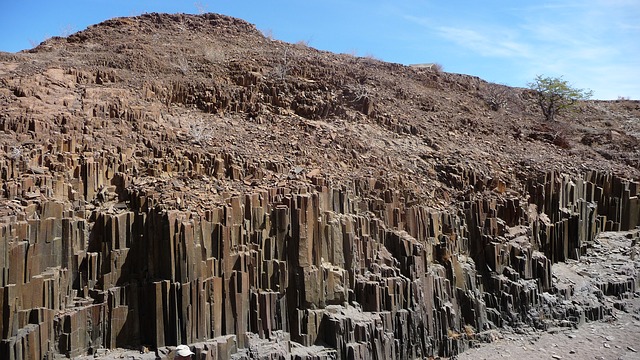 Enhanced weathering using basalt could remove up to 4.9 billion tons of CO2 per year
Under the Paris climate accord, efforts to curb CO2 emissions include removing CO2 through the use of sinks, as well as by reducing the amount that is produced. Tiny weathered rocks could be used to create one of those sinks, according to an assessment by the Potsdam Institute for Climate Impact Research.
While more research needs to be done on the economic feasibility and other impacts of such an undertaking, enhancing this natural process shows promise.
The goal to keep global warming well below 2 degrees Celsius "requires rapid and strong reductions of burning fossil fuels such as coal; but some emissions, for instance from industrial processes, will be difficult to reduce - therefore getting CO2 out of the air and storing it safely is a rather hot topic. The weathering of rocks, as dull as it might seem at first glance, is a scientifically exciting part of this," according to Jessica Strefler, one of the lead authors.
The idea is to use the natural ability of the minerals in weathered rock to chemically bind CO2, but on a grand scale. The process involves mining, grinding, transporting and distributing the rocks. Cost is one of the main impediments. Another is the shear magnitude of the project -- more than 3 billion tons of basalt (nearly half the current global coal production) spread over approximately one-fifth of the world's cropland to sequester 1 billion tons of CO2, according to Thorben Amann, also a lead author.
The study looked at two types of rock -- dunite and basalt. Dunite is substantially less expensive at $60 per ton of CO2 removed (but still more than double the cost of planting trees) and could remove up to 95 billion tons of CO2 per year, according to the scientists. However, dunite contains harmful substances such as chromium or nickel that could be released, making it a useful benchmark but an unacceptable option. Basalt, which is far more expensive at $200 per ton of CO2 removed, is estimated to remove 4.9 billion tons of CO2, but can act as a natural fertilizer by adding nutrients to the soil.
"We can say that enhanced weathering is not just a crazy idea but could actually help climate policy, yet it is still a challenge to get a precise understanding of the involved processes," said Amann.
The study is available on IOPScience.


I think it's great to research and consider all options, but also very relieved to see those options being costed and compared. Thus we know what could in theory be done, but cannot realistically be done.