Power Plants Bolster Gas Supply Reliability
David Wagman | February 27, 2018Most natural gas-fired power plants in the United States use firm contracts to buy their gas. The contracts obligate the natural gas producer and the pipeline operator to send fuel to the power plant when requested. These power plants using firm contracts reported receiving 71 percent of the natural gas purchased by power plants in 2016, according to the Energy Information Administration (EIA).
 About 16 percent of natural gas used for power generation in 2016 was purchased by plants that reported using only interruptible contracts. Under those contracts, the natural gas supplier or pipeline operator has the option of interrupting the fuel supply for contractually stipulated reasons. The remaining 13 percent of natural gas was purchased by plants through some mix of firm and interruptible contracts.
EIA says that the electric power sector surpassed the industrial sector in 2008 and the combined residential and commercial sectors in 2015 to become the largest consumer of natural gas in the United States. As the share of natural gas used for power generation has increased, so has the interdependence between natural gas supply and infrastructure and electric power generator operations.
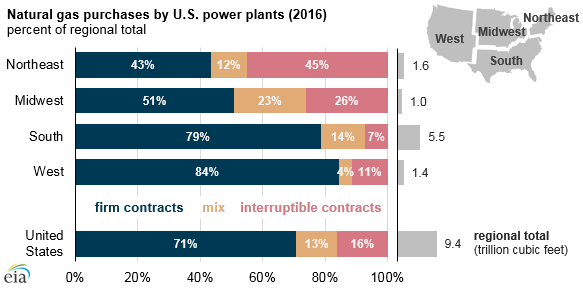 Credit: EIAFirm contracts and interruptible contracts are two broad types of contracts for purchasing natural gas, although the legal obligations for delivering natural gas between a fuel supplier and a natural gas-fired power plant can vary, depending on their specific agreements.
EIA says that transactions between power plants and natural gas suppliers generally include a supply component, which involves an agreement with a fuel producer or marketer to supply the commodity, and a delivery component, which involves an agreement with a pipeline operator to transport the fuel from the producer to the generator.
For any transaction, one or both of these components can be firm or interruptible. In most cases, power plants rely on one type of contract (either firm or interruptible) for both the supply and delivery component of the natural gas purchase contract.
Firm contracts provide power plant operators with an agreed-upon capacity for the producer or pipeline to supply natural gas. This sets up a high priority for fuel requested by the power plant. Supply or delivery of natural gas cannot be curtailed under a firm contract except under unforeseeable circumstances. Firm contracts are most prevalent in the West and South.
In contrast, interruptible contracts (also called nonfirm contracts) are lower-priority fuel supply and transportation arrangements, EIA says. Under these contracts, the flow of natural gas to a power plant may be stopped or curtailed if firm contract holders use the available capacity or if other interruptible customers outbid the power plant. These contracts are generally set up for short periods, often for next-day delivery.
Interruptible contracts are less expensive than firm contracts, reflecting the higher risk of disrupted fuel receipts. Interruptible contracts are most common in the Northeast -- in 2016, more natural gas in this region was purchased using interruptible contracts than firm contracts.