An Accidental Record: Two Cosmonauts Take Longest Spacewalk to Date
Lauren Mineau | February 07, 2018Two Russian cosmonauts recently ventured out to replace an antenna, and they ended up setting a record for the longest spacewalk ever conducted by a Russian cosmonaut, surpassing the previous record by six minutes. The spacewalk lasted 8 hours, 13 minutes.
Cosmonauts Alexander Misurkin and Anton Shkaplerov placed a critical antenna in the wrong spot outside the International Space Station. NASA's Mission Control determined the antenna was fine, but Russia's team said it needed to be dealt with. So, off they went.
This particular antenna was used for ISS communications with the Russian Mission Control.
The antenna initially got caught up on the Russian side of the ISS. The pair noticed it couldn't properly extend after being folded up the night before. The four-foot boom simply wouldn't budge. Both cosmonauts pushed the antenna with the help of flight controllers assisting remotely.
Finally, the Russian mission control team said in Russian, "It's moving. It's in place."
 Source: NASA
The Houston-based team at NASA Mission Control actually saw that the antenna moved 180 degrees farther than it should have.
While their goal wasn’t to set any records, in venturing out to fix something – they made history.
During the antenna movement issues, the cosmonauts still had to remove the old electronics from the antenna. One of those items was an original part which had launched in 2000. Misurkin pushed everything away from the space station. According to NASA, the items will float down and disintegrate upon meeting Earth's atmosphere without harm. The 60-pound box was also thrown in a direction in a path that won't interfere with the space station, NASA officials noted.
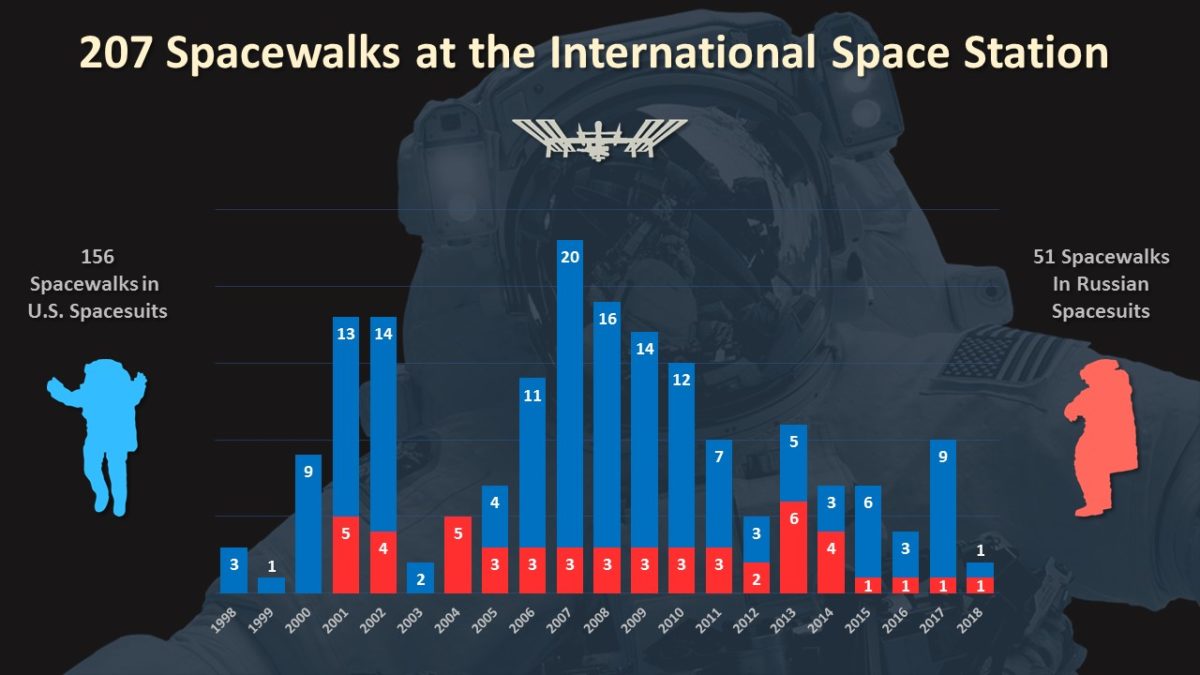
This was the 207th spacewalk in support of International Space Station assembly and maintenance, the fourth in Misurkin’s career, and the second for Shkaplerov. It is the fifth-longest spacewalk in human spaceflight history.
Learn more about station activities by following @space_station and @ISS_Research on Twitter.