Manure Management Implications for Agricultural Nitrous Oxide Emissions
S. Himmelstein | February 02, 2018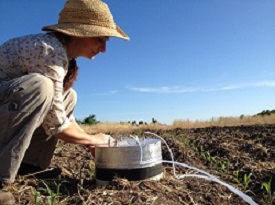 Gas sampling using photoacoustic gas analyzer. Source: Carol Adair
The agricultural sector is often cited as the largest global anthropogenic source of nitrous oxide, a greenhouse gas with a global warming potential 298 times that of carbon dioxide. The bulk of these emissions is associated with soil and nutrient management methods, including tilling and fertilizer use.
Researchers from the University of Vermont evaluated the impact of conventional versus no-till systems and broadcast versus manure injection on agricultural N2O emissions. The injection of animal manure, which is a good source of slow-release nitrogen, is being increasingly practiced as a means of avoiding pollutant runoff and waterway contamination problems associated with broadcast application.
While tillage practice has little impact on emissions, manure injection increases N2O emissions relative to broadcast. Spring manure application seems to result in shorter-lived N2O pulses relative to application in the fall. However, adverse impacts of injection are observed during spring thaw and freeze-thaw cycles, where soils with manure injection released nearly double the amount of N2O than soil with broadcast manure application.
The researchers theorize that cover crops grown between main-crop seasons may be able to reduce wintertime emissions.