Field Trials Document Energy Crop Potential in the U.S.
S. Himmelstein | January 17, 2018In 2008, the US Department of Energy and Sun Grant Regional Feedstock Partnership began testing herbaceous feedstocks across the continental U.S. and Hawaii. The initiative was designed to provide information for feedstock selection and management practice options for different regions, and to develop national maps of potential feedstock yield for each of the herbaceous species evaluated.
The bioenergy potential of switchgrass, Miscanthus, sorghum, energycane and prairie mixtures was evaluated in long-term trials spanning a wide geographical area. Due to shortages in plant materials, Miscanthus and energycane were grown on smaller plots than the other crops, but researchers say the new results are still valuable for producers.
Crops were grown for five to seven years in multiple locations and with varying levels of nitrogen fertilizer. Most of the crops are known to tolerate poor soil quality, and all benefitted from at least some nitrogenMiscanthus did best with an application of 53.5 pounds per acre.
Prairie mixtures yield kept increasing with the addition of up to 100 pounds per acre, but producers are advised to weigh the yield benefit against the cost of the fertilizer.
Miscanthus production was directly related to precipitation -- in areas where precipitation was down, yields generally dropped.
Instead of highlighting specific yields obtained in good years or locations, a group of statisticians within the research team used field-based yield and environmental data to create maps of yield potential for the five crops across the U.S. Dark green swaths on the maps represent areas of highest yield potential, between 8 and 10 tons per acre per year.
The greatest yield potentials for lowland switchgrass varieties are in the lower Mississippi valley and the Gulf coast states, whereas Miscanthus and prairie mixture yields are likely to be greatest in the upper Midwest. Energycane could reach very high yields, but in a relatively limited portion of the country.
The crop that shows the highest potential yields in the greatest number of locations is sorghum. The annual crop is highly adaptable to various conditions and might be easier for farmers to work with.
The full dataset is accessible via the Knowledge Discovery Framework.
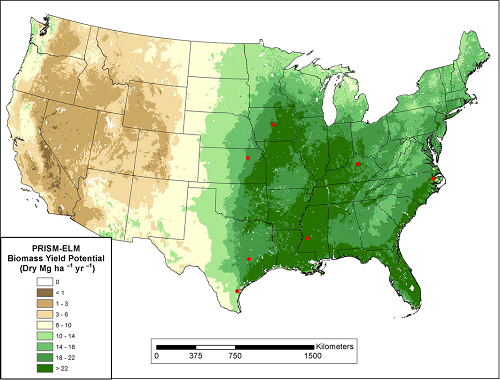 Biomass yield potential of sorghum for the U.S. generated using the PRISM-ELM model and based in part on Regional Feedstock Partnership Field Trials (red dots). Source: U.S. Department of Energy