Solar Powers Australian Deep-Space Ground Station
S. Himmelstein | November 29, 2017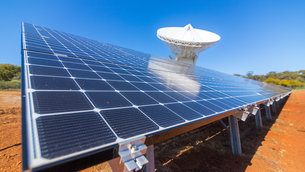 Solar panels at the New Norcia deep-space ground station. Source: ESAInaugurated in 2003, the New Norcia station in Western Australia was the first of the European Space Agency’s (ESA) trio of deep-space antennas. The others are located in Argentina and Spain, and all provide full communication coverage for spacecraft.
In common with spacecraft which use solar cells to power their missions, the New Norcia ground station now also relies on solar energy technology. A solar farm completed in August 2017 generates 470 MWh of electricity annually, providing about 40 percent of the station's power needs. The facility has 840 photovoltaic panels arranged in five double rows with a rated capacity of 250 kW and has already reduced the cost of purchasing electricity from the local power company by at least 30 percent.
The solar installation is expected to provide a full return on investment within about 15 years and to save 340 tons of carbon dioxide annually. ESA will consider upgrading the sites in Spain and Argentina with solar power as well.
In August 2016, New Norcia station received signals from the international Cassini spacecraft orbiting Saturn, across more than 1.4 billion km of space – the furthest 'catch' ever made by an ESA station.