
Evaporation: the Next Big Renewable Energy Source?
S. Himmelstein | September 27, 2017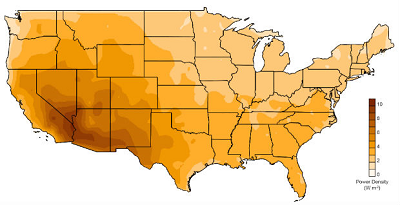 Southern and western U.S. states have the greatest capacity to produce evaporation-generated power from lakes and reservoirs. Source: Columbia University
The next big renewable energy resource might be extracted from thin air. Columbia University researchers have estimated the power available from natural evaporation from open bodies of freshwater, such as lakes and water reservoirs. The total power available in the United States approaches 325 GW, which is over 69 percent of the national electrical energy generation rate in 2015.
The analysis is based on the modeled effects and potential of an evaporation-driven engine, and on the impact of such engines on water resources and energy reliability. The researchers excluded prime locations such as farmland, rivers, the Great Lakes and coastlines to limit errors associated with modeling more complex interactions. They also made the assumption that technology to harvest energy from evaporation efficiently is fully developed.
Columbia University scientists have already demonstrated, on a very small scale, the potential for evaporation-harvested power. Electricity generated from this process can be produced on demand, in contrast to the intermittent nature of solar and wind energy.
Water conservation is an additional benefit of this technology, as evaporative water losses from lakes and reservoirs would be halved. This translates into one-fifth of the water consumed in the U.S., or 25 trillion gallonsper year.

See, you fooled me. I was thinking evaporate water, let it rise in the heat, then condense aloft (way up there aloft), and flow it back down under tremendous pressure at the bottom to generate using a turbine.
Engineering the very tall (mile high) tower might be an issue, not to mention containing the water pressure conveniently. Probably not much energy storage potential at the top.
'a shutter that opens and closes, prompting bacterial spores to expand and contract. The spores’ contractions are transferred to a generator that makes electricity'
??
In reply to #2
It might not work at all in Houston, Tx or in Thailand. Too humid to begin with.
In reply to #4
Would like to see Nm, RPM, $/kw
In reply to #9
& $/kWHr ;-)
In reply to #10
It always seems like these novelty items are the last to publish actual facts and figures related to engineering. Could that be because engineers are not the ones doing that research?
These guys are trying to pull a fast one, claiming that this conserves water.
They are claiming that because they are evaporating water which raises humidity the amount of evaporation from natural water sources will decrease thereby saving water. This is like claiming you are saving money by making a huge expenditure because there won't be money left over to spend so naturally spending will decrease.
In reply to #3
It seems the idea would be to cover largish areas with Engine Type 1, the one with the shutters, and have the average time closed greater than time open, or something like that.
Why does the article say, " water lost to natural evaporation" ?
Isin't water supposed to be given up ( not lost ) to natural evaporation ?
What research has been done, in relation to this research, on the effects to the natural environment if half of the water is not naturally evaporated ?
In reply to #6
If half of the water is not "naturally" evaporated, then half of it stays in the pond in West Texas, plain and simple.
There is no such thing as "unnatural evaporation", and if there was, we would have to arrest someone.
If the water is "given up to natural evaporation", it is still lost to the pond. It is all in the frame of reference. We did not destroy or make any water (chemically or physically) during the phase change. Do not adjust your volume, do not change the channel, we will restore control of your TV after this episode of "The Outer Limits" is complete.
In reply to #7
First: ha,ha. thanks for the outer limit reference.
Again your right, I just checked non equilibrium thermodynamics.
In reply to #8
non-equilibrium means that some of the usual thermodynamic rules are not in control of the action, in other words, kinetic control has taken over.
We, as human biological beings, are thermodynamic systems far from equilibrium (thank God).
Shaded water uptake, and water evaporation in sunlight can easily be viewed as a non-equilibrium system.
I do not see these microbe spore engines becoming a big business over night, as the energy source itself is a non-dense source. I do not see our companies attempting to get permits to cover up all surface waters (WOTUS) in an effort to generate mass electricity, and slow down evaporation loss.
Right now, this is merely a novelty, a spark of curiosity, not much more. At least it is not claiming this wild 220 kW in three seconds in a tea cup, like the nano-aluminum urine reactor for hydrogen seems to be claiming (erroneously).
In reply to #11
I will need to re-read your explanation several times to understand it and think about it for a while.
When I read this : ( I am limited by my keyboard by showing the correct symbols, so bear with me )
P eq, If P < P eq / P > P eq
If P = P eq - o where o > 0
o ( arrow pointing toward right ) 0
( Thermodynamics and the free energy of chemical substances )
( I like books like this, the combination of verbage and mathematics makes it much easier to understand concepts. )
This representation helped me to understand your previous answer to my question ( and that is why I said you are correct. )
I should have reviewed the reference material beforehand.
Thank you for taking the time to educate me.