Curbing Climate Change Agents at Aging Giant Oil Fields
S. Himmelstein | July 19, 2017The older and larger an oil field, the smaller the volume of petroleum produced. Despite a decline in resource extraction, the energy required to keep many of these fields operating can rise dramatically. As a result, emissions per barrel of oil extracted can double over a 25-year operating period.
These findings from a Stanford University study could have implications for estimating long-term emissions and for conducting climate modeling. Failure to consider the changing energy requirements of oilfields can cause oilfield managers or policymakers to underestimate the true climate impact.
A new software tool, the Oil Production Greenhouse gas Emissions Estimator (OPGEE), was used to determine greenhouse gas emissions for oil fields worldwide that have produced more than 1 billion barrels of oil over their lifetimes. The researchers stress the need to assess energy costs associated with every stage of the petroleum production process, and to do so for the oilfield’s entire lifetime, so as to define and reduce a field’s true climate impact.
OPGEE performs a lifecycle assessment for a given field by analyzing the extraction, refinement, and transportation phases of the oil production process. After computer models calculate how much energy is consumed during each step, scientists can calculate precisely how much greenhouse gas each oil field emits.
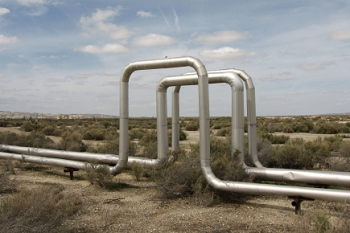 Steam lines from an enhanced oil recovery project in California. A new software tool developed at Stanford analyzes each phase of the oil production process – from extraction and refinement to transportation – to calculate how much energy is consumed during each step and how much greenhouse gas an oil field emits. (Image credit: Adam Brandt)Analysis of data going back decades for 25 globally important super-giant oil fields revealed that for many of the sites, oil production declined with time as the wells were depleted, but the energy expended to capture the remaining oil increased. To extract the remaining oil, producers use increasingly energy-intensive recovery methods, such as water, steam or gas flooding.
More intense surface processing must be applied to oil extracted by these methods to filter out the excess water and gas. This can result in an excess of carbon dioxide and methane gas that is typically eliminated through flaring.
Government regulations that force companies to reduce their greenhouse gas emissions or risk having to lower production have been shown to work at two Canadian offshore fields. Emissions declined at these sites by limiting oil production where gas is wasted through flaring and venting.
Another solution: encourage energy companies to draw the energy needed to operate aging oil fields from renewable sources such as solar, wind or geothermal. GlassPoint Solar, Calif., uses solar-powered steam generators to reduce the gas consumption and carbon emissions of its oil fields by up to 80%.