NASA to Launch Probe to "Touch the Sun"
Peter Brown | May 31, 2017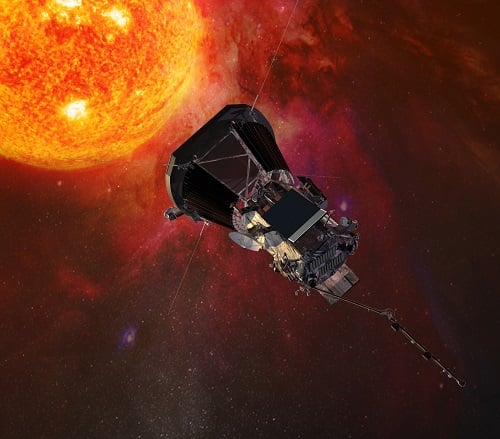 An artist rendition of the Parker Solar Probe. Source: NASANASA is planning to send a probe to the sun that will be placed in orbit within four million miles of the surface of the star, the closest of any spacecraft ever.
The goal is to study the outer atmosphere and make observations that will hope to answer questions about the physics of how stars work. The data garnered from the probe will improve forecasts of major space weather events that impact life on Earth as well as satellites and astronauts in space.
The probe, known now as the Parker Solar Probe in honor of astrophysicist Eugene Parker, will launch in 2018. The spacecraft will face intense heat and radiation unlike any in history. The probe will use seven Venus flybys over nearly seven years to gradually shrink its orbit to around the sun, coming well within the orbit of Mercury — eight times closer than any spacecraft before it.
“The solar probe is going to a region of space that has never been explored before,” Parker said. “It’s very exciting that we’ll finally get a look. One would like to have some more detailed measurements of what’s going on in the solar wind. I’m sure that there will be some surprises. There always are.”
Solar wind has proven to exist repeatedly through direct observation and Parker surmises this is the result of energy being given off by the sun in a cascade effect that comprises a mix of plasma, magnetic fields and energetic particles.
“Parker Solar Probe is going to answer questions about solar physics that we’ve puzzled over for more than six decades,” said Nicola Fox of the Johns Hopkins University Applied Physics Laboratory and scientist for the Parker Solar Probe project. “It’s a spacecraft loaded with technological breakthroughs that will solve many of the largest mysteries about our star, including finding out why the sun’s corona is so much hotter than its surface.”
The probe is slated for launch during a 20-day window that opens on July 31, 2018 as part of NASA’s Living With a Star program exploring the sun-Earth system that affects all life and society.