Gas-fueled SOFC Powers Electric ATV
S. Himmelstein | March 29, 2017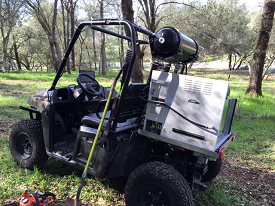 Prototype vehicle with CNG tank installed. Image credit: Ascend Energy
A newly developed tubular solid oxide fuel cell (SOFC) was demonstrated in an electric all-terrain vehicle (ATV) in a project funded by the California Energy Commission. A 1,000 W ceramic fuel cell with zirconium oxide electrolyte developed by Massachusetts-based Atrex Energy was installed by Ascend Energy in an all-electric Polaris Ranger ATV.
While most SOFCs use a planar design—thin sheets of material forming the layers—Atrex developed a tubular design in which the layers are added to a cylindrical base. The design allows conventional hydrocarbon fuels such as natural gas or propane to be used directly without requiring an external reforming process. There is no need to transport or store hydrogen, avoiding another layer of complexity.
Multiple trials on a rugged off-road vehicle course demonstrated the durability and performance of the compressed natural gas-fueled SOFC. Use of an onboard fuel cell recharger increased the range 350 percent on a real world 2.3-mile (3.7 km) off-road test loop. Fuel consumption was one-third that of a conventional gasoline version under the same conditions. The fuel cell vehicle also had no detectable sulfur oxides or nitrogen oxide emissions in contrast to the 100+ ppm of nitrogen oxides in gasoline vehicle exhaust.
The demonstration also showed the vehicle could be the most economical form of a fuel cell hybrid in terms of fuel cost. A conventional gasoline vehicle would use $9 of fuel to travel 100 miles and a hybrid electric-type vehicle would require $7.50 worth of fuel. A hydrogen fuel cell car would use $20 of fuel for the same trip, but an equivalent ceramic fuel cell vehicle would use only $6 worth of fuel.
The ATV was chosen because over 200,000 of them are used by farmers and ranchers in the Central Valley and contribute to air pollution when powered with small gasoline or diesel engines.