Cummins Accelerates Its Water Intensity Reduction Efforts
David Wagman | March 21, 2017Cummins Inc. says it increased its facility water goal to a 50% intensity reduction by 2020 from a baseline of 2010. It made the announcement to mark World Water Day on March 22.
Cummins released its water conservation goal in 2014 as part of its 2020 Environmental Sustainability Plan. At the time it pledged to cut water use intensity by 33%, adjusted by labor hours.
 As of the third quarter of 2016, the company says its water efficiency efforts had resulted in a 42% intensity reduction or 18% on an absolute basis.
The revised 50% intensity reduction goal represents a total water savings of 763 million gallons of water since 2010.
The company says it has installed low-flow fixtures and efficient equipment, bioswales and regenerative dynos, low water use landscaping, stopped water leaks, and otherwise worked toward efficient processes in its facilities.
The company says its water strategy addresses both direct water use and community engagement. Cummins says its effort is intended to mitigate business risk, to be a good global citizen, and to reduce costs and compliance risk.
In its water management program, the company uses innovative assessment tools such as the Ceres Aqua Gauge, a global water risk screen and the “true cost” of water assessment that identifies water costs embedded in activities such as pumping, electricity and chemical use.
To achieve the 50% reduction, Cummins says it will expand the work it does with its sites in water program management, including with higher water use locations, water balance creation, and sub-metering. The company also has plans for an alternative bio-tech system for producing high quality treated wastewater for process reuse at one of its engine plants.
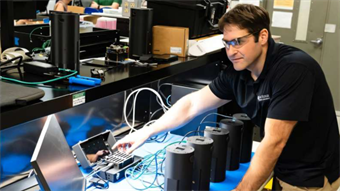
Cummins uses regenerative dynamometers (dynos) to capture the mechanical energy of engines in test cells. The dynos also reduce cooling load, which allows cooling systems to be smaller and use less water.
Many Cummins buildings have specific features designed to conserve water. The bioswales at the new Distribution Business Unit headquarters in Indianapolis, Ind., for example, are part of a system designed to keep about 80% of rainwater on the site to use for landscaping. The bBioswales collect and save water that would otherwise run into the city’s sewer system. Plants in India and Brazil recycle water for non-potable uses and several locations have features like low or no-water toilet facilities to help meet their water-use goals.
Cummins also has a water neutrality goal that embodies the company’s aspiration to work with its communities to ensure that everyone has adequate, safe, and sustainable water supplies. By 2020, Cummins plans achieve water neutrality (offset the water it uses) at 15 facilities in water-stressed communities. This goal is aligned with the United Nations Sustainable Development Goal 6 for Clean Water and Sanitation.