Sounding the Trumpet for CNC Machine Tools
Engineering360 News Desk | February 22, 2017The David G. Monette Corp in Portland, OR, produces trumpets for some of the greatest performers in the world such as jazz great Wynton Marsalis.
Each instrument has about 150 individual parts per horn and approximately 85% of them involve some type of machining. But meeting the demands for musical performance of world class artists also means achieving extreme levels of machining precision and quality. (Watch a video.)
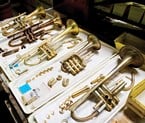 Musical perfection requires extreme levels of machining performance"If we machine a trumpet's bottom valve caps 0.001" too small or make them 0.2gm too light, for instance, it will drastically change what is known as the horn's pitch center," says David Monette, president and owner. "That, in turn, alters the whole sound of the horn and basically throws it out of whack musically."
Monette says that the company started out by machining trumpet mouthpieces and eventually entire horns on manual machine tools. But that approach stifled the freedom to experiment and also imposed speed restrictions that forced the shop to farm out most of the parts.
In turn that tactic was found wanting: "The best job shop in town was unable to make parts to our satisfaction," explains Monette. The solution was to become a user of modern CNC machine tools. "We brought all our parts production in-house and we now painstakingly make every part perfect,” he says.
Monette's fleet of advanced CNC machine tools was supplied by Mazak Corp. and includes a Quick Turn Nexus (QTN) 100 turning center, Quick Turn Smart (QTS) 200 turning center and a Vertical Center Nexus (VCN) 410A vertical machining center. What they make possible in terms of speed and flexibility of manufacturing is considerable: "We can now design a new prototype mouthpiece shape and 10 minutes later test it on a horn, gather instant feedback and re-machine the shape until it is perfect. We often have musicians or waiting in our office for their particular mouthpiece or other component to be machined so they can test it immediately."
Monette's parts are all brass and nickel, except for its split die tooling, which is tool steel. The shop produces its own split dies used to form the trumpets' tuning slides and tubing. Each involves different-size tubing and slides that can require up to 27 different dies to produce.
Parts must be perfect. For instance, a size variation of just 0.0001 in. on the taper of a mouthpiece shank equates to it sliding into a horn 0.002 in. too deep, which would seriously impair the quality of the instrument. So Monette works to tolerances in the 0.0001 in. range. Moreover because work materials are so soft, the shop machines at much slower speeds and feeds than a more conventional outfit. Mouthpiece blanks, for instance, take seven minutes to rough cut. After brazing all the parts together, the shop machines brace components that fit between the tubing and support the assembled structure.