Smart Lightning Sensors for Aircraft
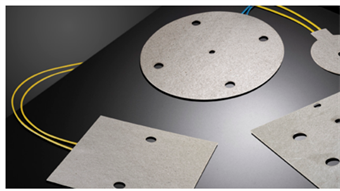
Engineering360 News Desk | February 12, 2017 The SansEC sensor can be applied to an aircraft and utilized as a smart skin. Source: NASA’s Langley Research Center
When conventional aircraft are struck by lightning, the result can range from no damage to serious damage that requires extensive repairs. Now new structural health monitoring sensors from NASA's Langley Research Center can cover a selective area of the aircraft surface, providing both mitigation and damage sensing.
The SansEC technology is a proven wireless sensing platform capable of measuring the electrical impedance of physical matter in proximity to the sensor based on a change in its resonance response. The sensor also exhibits a unique characteristic to disperse the lightning strike current to help mitigate lightning damage.
When a lightning leader propagates through the atmosphere near an aircraft, the lightning electromagnetic emissions generated from the moving electrical charge will radiate the aircraft surface before the actual strike to the aircraft can occur. As the lightning leader propagates closer to the aircraft, the radiated emissions at the aircraft will grow stronger. By design, the frequency bandwidth of the lightning radiated is in the range for SansEC resonance, and the sensor coil will be passively powered by the external oscillating magnetic field of the lightning radiated emission.
The coil will resonate and generate its own oscillating magnetic and electric fields. These fields generate so-called Lorentz forces that influence the direction and momentum of the lightning attachment and thereby deflect/spread where the strike entry and exit points/damage occur on the aircraft.