Semi-Autonomous Buses Proposed to Reduce Traffic
John Simpson | October 14, 2016Kennesaw State University engineers believe that a speedy, semi-autonomous bus design they have developed could help ease traffic congestion.
Bill Diong, associate professor of electrical engineering; Ying Wang, associate professor of mechatronics engineering; and Jidong Yang, assistant professor of civil engineering are exploring a solution to make bus rapid transit (BRT) more appealing to commuters and more cost-effective for communities. The concept to improve BRT's attractiveness as a commuting option centers on their proposed Slim Modular Flexible Electric Bus (SMFe-bus).
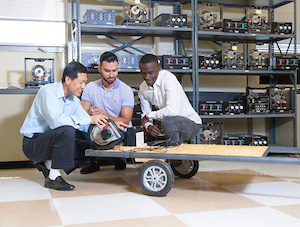 Associate Professor of Electrical Engineering Bill Diong (l) works with graduate student researchers to develop autonomous in-wheel motors. Image credit: Lauren Lopez de Azua.The SMFe-bus has a lead module with a human driver and several driverless modules strung together behind that are not physically attached to the lead vehicle or to each other. Each module is self-propelled by in-wheel electric motors. With gull-wing doors and three-seat wide rows, the bus has a slimmer frame that can travel in narrower dedicated lanes.
“It is a semi-autonomous vehicle, where each driverless module is programmed to follow the module preceding it,” says Diong.
What makes their BRT concept unique is that the modules are uncoupled, leaving a small gap of space between each self-driving unit. The modules are programmed to coordinate their spacing and alignment in a "virtually coupled" fashion, which allows for flexible bus capacity. Modules can be easily added or removed from the vehicle over the span of a day, in sync with varying passenger demand.
Sensors gauge the lead vehicle’s movements, and the principle, Diong says, is for them to stay fairly close but far enough apart so if the lead module’s driver brakes suddenly, the autonomous modules can respond quickly to avoid colliding with each other. With safety features built into their system, the modules can swiftly change speed and direction.
“Our prototype explores the neural network and benefits from artificial intelligence technology and how a machine, or robot, learns how to accept information from humans,” says Wang. He adds that significant progress in computer vision technology, such as cameras to classify objects, and the speed of today’s graphics processing units are improving high-level decision making for the autonomous vehicle industry.
BRTs already have signal priority—the ability to change traffic lights to favor their pathway as they approach intersections—which aids in on-time scheduling for the transit system, says Yang. He is now working on the feasibility aspects of the concept and the infrastructure design components to support its operations. The feasibility study will look at two potential BRT corridors in the Atlanta metro area.
As part of the team’s research, four undergraduate and three graduate engineering students are working to develop a prototype SMFe-bus, which is being designed to operate at a top speed of 65 miles per hour. And while the SMFe-bus will cost more than a traditional bus, its narrower dimensions and adjustable capacity could result in substantial cost savings in land acquisition, roadway construction and service operation—perhaps as much as 20%, according to the research team.