Smart Window Material Could Boost Energy Efficiency
Chuck Heschmeyer | October 05, 2016A thin, flexible smart window material developed by engineers at the University of Texas at Austin could double the energy efficiency of conventionally processed materials. When incorporated into windows, sunroofs, or even curved glass surfaces, the coated plastic controls both heat and light from the sun in order to regulate inside temperatures and reduce energy consumption.
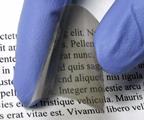 A darkened electrochromic film on plastic prepared by chemical condensation. Source: Cockrell School of Engineering, University of Texas at AustinThe advancement is a new low-temperature process for coating the new smart material on plastic, which makes it easier and cheaper to apply than conventional coatings made directly on the glass itself. An electric charge of about 4 volts can lighten or darken the material and control the transmission of heat-producing, near-infrared radiation.
The low-temperature process was developed by UT researchers in collaboration with scientists in Europe. The method generates a material with a unique nanostructure, which doubles the efficiency of the coloration process compared with a coating produced by a conventional high-temperature process. It can switch between clear and tinted more quickly, using less power, the researchers say.
As explained by the researchers, this new electrochromic material, like its high-temperature processed counterpart, has an amorphous structure, meaning the atoms lack any long-range organization as would be found in a crystal. However, the new process yields a unique local arrangement of the atoms in a linear, chain-like structure.
Whereas conventional amorphous materials produced at high temperature have a denser three-dimensionally bonded structure, the new linearly structured material, made of chemically condensed niobium oxide, allows ions to flow in and out more freely. As a result, researchers say it’s twice as energy efficient as conventionally processed smart window material.