Recycled Tires Could Help Earthquake-Proof Bridges
John Simpson | June 16, 2016Academics from the University of Surrey and Aristotle University of Thessaloniki have proposed a new method of protecting bridge infrastructure in disaster-prone regions using tires that might otherwise be sent to landfills.
In developing countries, where there is a need to build bridges using inexpensive construction methods, the integral bridge has been a popular choice—a simple frame structure with no extra parts, such as bearings or expansion joints. "It is maintenance-free but has limitations, meaning that [it] can only be used over short lengths," says Dr. Stergios Mitoulis lecturer of bridge and structural engineering at the University of Surrey. "Where the bridge meets the land, the soil moves and shifts, and in times of stress this can lead to extended damages or collapse. The longer the bridge, the greater the risk of collapse.”
The challenge for the researchers was to find an inexpensive and effective material to bolster bridges, providing support but also a buffer capable of withstanding the force of earthquakes regardless of bridge length. The team turned to conventional tires, of which 50 million are discarded in the UK alone each year. The waste tires can be used to create a new product—the isolator—a flexible and elastic layer used to absorb movements and reduce repair costs.
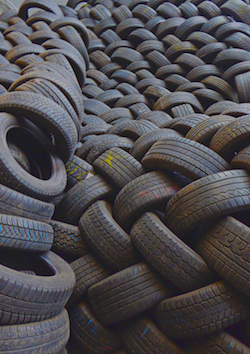 50 million tires are discarded in the UK each year. Image credit: Pixabay.“As with many of the challenges we face in engineering, the answer came from an unexpectedly simple source,” says Mitoulis. “We were looking for a readily available, cheap and effective material that would keep its cool under pressure. That’s when we thought about the possibility of recycling common tires and putting to good use a material destined for landfill."
According to Mitoulis, tires can be recycled to create an aggregate that provides effectively double the performance of conventional designs when movements due to earthquakes or temperature changes are simulated. The new design could eventually allow for safer and sturdier bridges in areas that do not have the means to erect expensive structures that require extensive maintenance.
Mitoulis' team is now looking for new market opportunities for the recycled isolators across a range of infrastructure assets that could benefit from the technology, including building foundations and quay and retaining walls.