Nanowire as a Basis for Rechargable Batteries
Riia O’Donnell | May 02, 2016University of California at Irvine scientists have invented a battery that can be recharged hundreds of thousands of times. Their nanowire-based battery material could be the first step toward batteries that never need replacement.
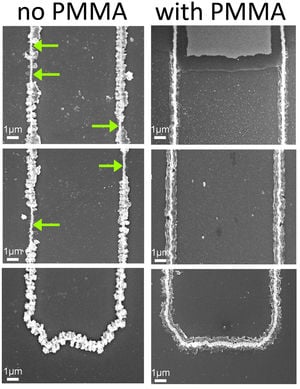 Gold nanowire in a manganese dioxide shell with and without PMMA coating. Image credit: Rajen Dutta /University of California IrvineAlthough nanowires are highly conductive and hold a large surface area to store and transfer electrons, they have been difficult to use in batteries. Nanowires are fragile and fail under repeated cycling: they can expand and grow brittle, then ultimately crack. To resolve the issue, the team coated the nanowire made of gold in a manganese dioxide shell and then encased it in an electrolyte made from a gel similar to Plexiglas.
Over a three-month period, the electrode was cycled 200,000 times with no loss of power or capacity and they could detect no fracturing of the nanowires. The study showed the battery held rates “with 94–96% average Coulombic efficiency.” Essentially, at the end of the three-month experiment, the battery was like new.
Study leader Mya Le Thai coated the wire with a thin gel layer of PMMA and began to cycle it. She noted that the wire cycled far longer than the typical 5,000-7,000 times, up to 200,000. The team believes the gel plasticizes the metal oxide in the battery, preventing it from cracking and providing flexibility. Additionally, the coated electrode will hold its shape better, making it more reliable. The team believes that in standard applications, the battery could last up to 400 years.