Servos Can Help Prevent Machines from Falling Down
Engineering360 News Desk | April 27, 2016Eccentricity machined into rolls can cause wobble—defined as the angular deviation of the axis of rotation over one revolution. And wobble can affect machine performance. As load varies, so does torque; as a result, motor acceleration increases.
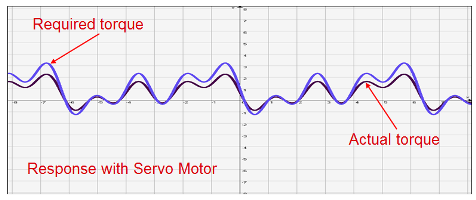 Servo-based motion-control systems can outperform conventional systems. Image source: Kollmorgen.With an induction motor, we expect to deliver a fixed torque at a fixed/constant speed. But, as explained in a Kollmorgen blog post by senior applications engineer Mahendra Kanex, servo systems can outperform conventional systems when dealing with eccentricity issues.
(See the Engineering360 guide to servo drive products, suppliers and catalogs.)
To maintain constant speed, a motor must respond to changes in torque every 100 ms (for a roll running at 600 RPM).However, with an induction motor, torque rise time is approximately 350 to 400 ms. Therefore, a normal induction motor often cannot respond quickly enough to load variations caused by eccentricity. And, the greater the number of connected rolls the greater the load variation, Kanex says.
A permanent-magnet synchronous servo motor can help by providing torque rise times of 80 to 100 ms. And, a servo drive provides a current-controller cycle time of 670 ns, helping the servo motor achieve the desired response.