Inflatable Habitat "BEAMed" Up to the ISS
By Engineering360 News Desk | April 19, 2016The first human-rated expandable structure for use in informing the design of deep-space habitats is set to be installed at the International Space Station (ISS) on April 16.
The Bigelow Expandable Activity Module (BEAM) will be attached to the station’s Tranquility module over a period of about four hours. Controllers in mission control at NASA’s Johnson Space Center, in Houston, will remove BEAM from the unpressurized trunk of SpaceX’s Dragon spacecraft, using the robotic Canadarm2, and move it into position next to Tranquility’s aft assembly port. NASA astronauts aboard the station will secure BEAM using common berthing mechanism controls.
BEAM launched aboard Dragon on April 8 from Cape Canaveral Air Force Station, in Florida. At the end of May, the module will be filled with air to expand to four and a half times its compressed size of 7 feet in diameter by 8 feet in length—to become roughly 10 feet in diameter and 13 feet in length. Astronauts will first enter the habitat about a week after expansion and, during a two-year test mission, will return to the module for a few hours several times a year to retrieve sensor data and assess conditions.
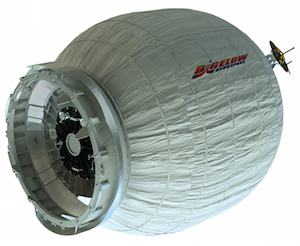 BEAM weighs approximately 3,000 pounds and has 560 cubic feet of pressurized volume. Image credit: NASA.BEAM weighs approximately 3,000 pounds and has 560 cubic feet of pressurized volume. The module’s skin is made up of multiple layers of soft materials. From inside to outside, the layers consist of the air barrier (bladder), restraint, micro-meteoroid and orbital debris (MMOD) layers, external MLI layers and an exterior BETA cloth.
The restraint provides the primary structural load-bearing member of the BEAM module. BEAM's MMOD shield is designed and tested to the low-Earth orbit MMOD environment and is intended to stop any particles from breaching the primary structural restraint layer and the gas bladder. According to NASA, the probability of penetration is extremely low but, in the event that it happens, the module is designed to leak slowly rather than burst so as to avoid damage to the rest of ISS.
Another feature of the fabric skin of BEAM is its ability to better absorb noise for a quieter habitable volume than the aluminum walls of the ISS modules—although during the two-year test period, BEAM will not be used for storage nor will it be occupied. The module will, however, be constantly monitored for temperature, pressure and radiation.
Expandable habitats are designed to take up less room on a rocket, but provide greater volume for living and working in space once expanded—which will be important for NASA's planned journey to Mars. This first test of an expandable module will allow investigators to gauge how well the habitat performs overall and, specifically, how well it protects against solar radiation, space debris and the temperature extremes of space. Once the test period is over, BEAM will be released from the space station and burn up during its descent through Earth’s atmosphere.