Future buildings could be made with prickly pear cacti
Marie Donlon | June 15, 2026A team of researchers from the University of Bath's Department of Mechanical Engineering is turning agricultural waste from prickly pear cactus plants into a low-cost, low-carbon reinforcement for construction materials.
The team explained that traditional composite materials combine strong reinforcing fibers with a lightweight base material, called a matrix. Common composites like carbon fiber, fiberglass or Kevlar rely on synthetic fibers in addition to energy-intensive manufacturing processes. Thanks to their durability, it also makes them tough to reuse or recycle at the end of their life. By substituting synthetic fibers with natural alternatives, however, the team believes they can offer a renewable and biodegradable solution.
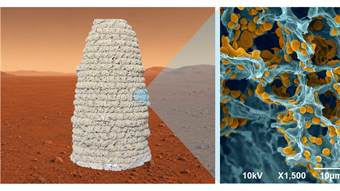
 Structure of OFI cacti, OFI cladode, single layer FN, and an individual plant fiber. Source: Journal of Natural Fibers (2026). DOI: 10.1080/15440478.2026.2655415
The team explained: "Inside the flat cactus pads is a naturally occurring fiber network. These fibers form a honeycomb-like structure that helps the plant support its own weight and resists bending in strong winds. We're exploring how to extract these structures and keep them intact, borrowing their natural properties to reinforce bio-based composites."
Although plant-based fibers like flax and hemp have already been investigated as natural alternatives to synthetic fibers, their cultivation is accompanied by environmental costs, such as land use, water demand and the need for pesticides and fertilizers. However, the use of agricultural waste promises to eliminate these challenges and offer a low-cost, low-impact and readily available alternative.
Specifically, the team investigated the prickly pear cactus — otherwise known as Opuntia ficus-indica, which is a fast-growing cactus that thrives in hot, dry conditions.
To turn the cactus waste into valuable construction material, the team separated usable fibers without damaging their natural structure. Currently, the team explained that they are exploring how these cactus-derived fibers bond with bio-based resins to develop fully sustainable composites. The team examined two different approaches for extracting the fibers from discarded cactus pads.
The first approach, called water retting, is a traditional technique used to process flax. This approach involves soaking plant material in water for multiple weeks so that the soft tissue rots away, enabling clean fibers to be removed and then dried.
The second approach employs changing water pressures that flush out the soft plant material, thus reducing processing time by roughly 90%.
While the water retting approach takes longer, it created cleaner and stronger fibers with fewer unwanted residues that could potentially weaken the final product. Further, the team also discovered that the fibers extracted from older cactus pads proved stronger and easier to separate than the fibers from younger plants, which makes them more appropriate for use in composite materials.
In the lab, when the cactus fibers were mixed into plastics, the material became markedly stiffer and stronger than either component independently, especially when they were bent or lightly impacted. These cactus derived-composites reportedly performed well at the temperatures used in low-heat manufacturing, however they are not appropriate for very high-temperature or high-stress applications, the team cautioned.
As such, the team suggested that these cactus-derived materials could be appropriate for use in lightweight, low-load use cases, such as non-load-bearing wall panels, lightweight cladding, automotive interior components or sports equipment such as surfboard cores.
An article detailing the work, “Extraction and Characterization of Opuntia ficus-indica Fibrous Networks from Agricultural Waste for Sustainable Biocomposites,” appears in the Journal of Natural Fibers.