New routing algorithm delivers disaster aid faster while improving fairness
Marie Donlon | April 28, 2026A new algorithm from researchers at Koç University, Polytechnique Montréal and the University of Vienna reportedly makes it possible for a faster and more equitable distribution of relief supplies in the aftermath of a disaster.
According to the algorithm’s developers, by integrating fairness into logistics planning, the model reduces inequality in unmet demand by roughly 34% without having to sacrifice delivery speed. As such, the team suggests that this approach promises to offer a tool for improving decision-making in real-world emergency response operations.
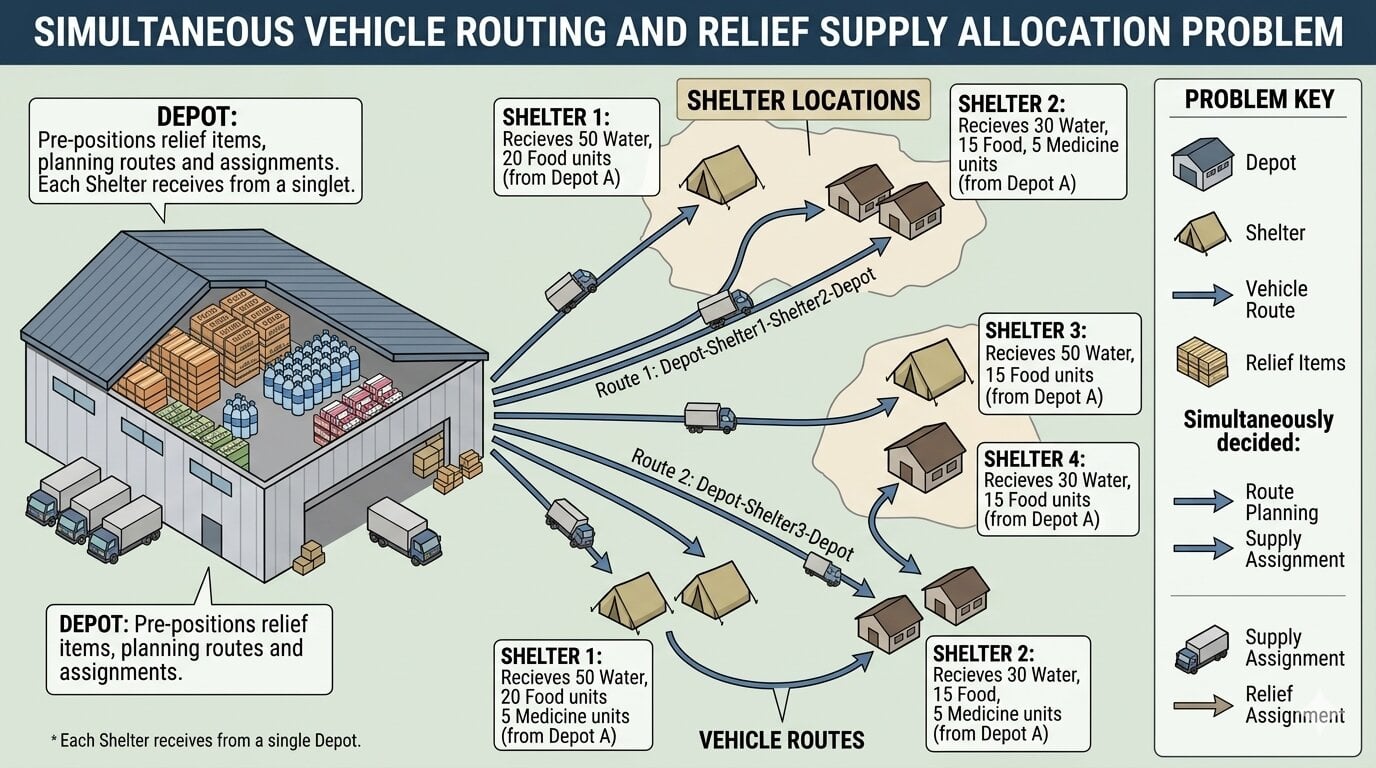 Source: European Journal of Operational Research (2025). DOI: 10.1016/j.ejor.2025.01.032
Looking at the data from the aftermath of a recent natural disaster, the researchers set out to determine how limited relief supplies could be delivered both quickly and fairly.
As such, the research team created the mathematical model and a solution algorithm to plan delivery truck routes and determine how much aid each theoretical shelter should receive.
According to its developers, the algorithm simultaneously optimizes routing and allocation decisions. Not only does it determine where and when aid is delivered, it also determines how much each location should receive within a single integrated framework.
The model seeks to align two competing objectives, the team explained. It aims to minimize total travel time to ensure quick delivery and minimize inequality in unmet demand across shelters so that no region is left disproportionately disadvantaged.
Beyond measuring fairness, the team incorporated the Gini coefficient, which is widely used in economics to quantify inequality, directly into the optimization model, thus turning fairness into a decision-making objective.
This so-called “branch-and-price” algorithm breaks disaster-aid optimization problems into manageable parts, thereby enabling fast, near-perfect solutions. Trialed on both real and simulated scenarios, the algorithm outperformed conventional tools, cut inequality in the distribution of aid by roughly 34% and maintained delivery speed — showing that balancing fairness and efficiency is critical under realistic time constraints.
An article detailing the work, “A branch-and-price algorithm for fast and equitable last-mile relief aid distribution,” appears in the journal European Journal of Operational Research.