Forward osmosis for food concentration
Jody Dascalu | May 28, 2026The food and beverage industry is moving away from energy intensive thermal evaporation in favor of cold concentration technologies. Traditionally, concentrating liquids like fruit juices or dairy required significant heat, which often degraded sensitive flavor compounds and bioactive nutrients. Forward osmosis (FO) represents a shift toward a more sustainable and quality focused model by using osmotic pressure to remove water as an alternative to heat or high hydraulic pressure.
This process relies on a semi-permeable membrane and a high concentration draw solution to naturally pull water molecules away from the food product. Because it operates at ambient temperatures, the system excels at retaining vibrant colors, volatile aromatics and antioxidant properties that thermal methods typically destroy. Recent validations have demonstrated that these membrane processes, particularly when integrated into hybrid systems, provide a path to high concentration levels with a significantly lower energy and water footprint. As manufacturers look to meet consumer demands for fresh tasting products while hitting sustainability goals, FO is emerging as a critical tool in modern food processing.
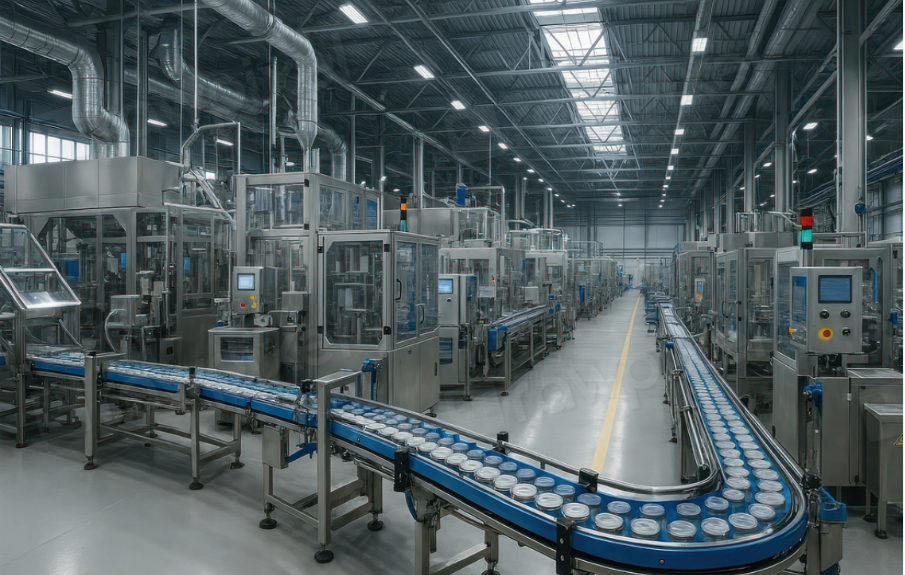 Automated production line and control interface within a modern food processing facility. Source: Raw Pixel
System architecture and mass transport mechanisms
An FO system is built around the interaction between the feed stream, a semi-permeable membrane and a concentrated draw solution. Water moves naturally across the membrane because of the difference in osmotic pressure between the two sides. As water leaves the food stream and enters the draw solution, the product becomes more concentrated without exposure to thermal or mechanical stress.
This transport happens through a thin selective layer supported by a porous structure that gives the membrane its strength. The selective layer controls what passes through, while the support layer influences how easily water can move across it. Together, they determine how efficiently the system can sustain water flux during operation.
Performance depends on how well the osmotic driving force is maintained across the membrane surface. Flow conditions on both sides are managed to keep concentrations uniform and avoid localized dilution of the gradient. When this balance is maintained, the system can steadily remove water while preserving the composition of the product.
Membrane properties play an equally important role. A well-designed membrane allows high water permeability while limiting the movement of draw solutes back into the feed. This ensures that concentration occurs without introducing unwanted changes to flavor, composition or stability. FO is best understood as a controlled diffusion system where membrane structure and flow conditions dictate how effectively water can be removed. The result is a stable, low-temperature concentration step that fits naturally into modern food processing lines.
Operation and process design considerations
Process design in FO is largely defined by the draw solution and how the system handles different product streams. The draw solution must create enough osmotic pressure to drive water removal while remaining practical to recover and reuse. In food applications, it also needs to be compatible with the product in case of minor crossover, so simple salts or sugars are typically used.
System configuration is adjusted based on viscosity and solids content. Low-viscosity liquids can be processed in high surface area membrane modules, while thicker products require more open flow paths to maintain stable operation. Across both cases, conditions are kept near ambient to preserve product quality and avoid the degradation associated with heat.
Performance is ultimately judged by how efficiently the system reaches target concentration levels. This is controlled through flow conditions and draw strength, with the aim of removing as much water as possible while keeping the product stable and easy to handle. A well-balanced system maintains steady flux and delivers a consistent, high-quality concentrate without introducing unnecessary complexity.
Hybrid membrane integration in concentration processes
Industrial-scale FO typically functions as a component of a multi-stage concentration system. Pressure-driven filtration handles the initial stages, where low viscosity allows for efficient water removal under moderate operating conditions. As concentration increases, the fluid becomes more resistant to flow, and further gains through pressure alone become limited.
FO is introduced at this point to continue water removal without increasing mechanical load. Because the driving force is osmotic, the process remains effective at higher solids content, where conventional filtration approaches lose efficiency. This allows the system to extend concentration beyond the limits of pressure-driven operation.
The combined approach distributes the separation work across different mechanisms. Early-stage removal is managed through pressure, while later-stage concentration relies on diffusion-driven transport. This reduces the need for extreme operating conditions in any single step and helps maintain consistent processing conditions throughout.
Hybrid configurations reach higher final concentrations while preserving product stability. The process remains near ambient conditions to avoid thermal stress and maintain the original characteristics of the feed as concentration increases.
Control, validation and maintenance
Reliability in FO systems is maintained through active fouling mitigation and strict quality protocols. Unlike the high hydraulic pressure used in reverse osmosis, which tends to compact debris into a hard cake layer on the membrane, the lower pressure environment of FO results in a more reversible fouling layer. This makes the membranes easier to clean and extends their operational lifespan. Regular maintenance cycles ensure that the flux remains consistent and the osmotic gradient is not compromised by surface accumulation.
Quality retention is verified by monitoring physicochemical properties throughout the concentration process. Parameters such as pH, water activity and titratable acidity are tracked to ensure the product remains stable over extended storage cycles. Additionally, rejection rates are validated to confirm that the membrane effectively blocks micropollutants and organic compounds. This ensures that the final concentrate meets both safety standards and the sensory expectations of the consumer.
Efficiency, tradeoffs and industrial scalability
Transitioning to FO involves a clear tradeoff between reduced electrical load and the complexity of draw solution management. While this method significantly lowers the energy required for pumping compared to high-pressure filtration, it introduces the need for an efficient recovery system to regenerate the draw solution. The overall energy balance of the plant depends on whether this regeneration is handled via thermal evaporation or a secondary membrane process.
Water footprint is a major driver for scaling this technology, as it allows for the recovery of high-purity water from food streams for reuse within the facility. However, economic barriers remain, particularly the cost of specialized FO membranes and the technical challenges of managing large solutes. For industrial-scale adoption, the focus is on proving long-term membrane durability and refining the recovery process to ensure the system remains cost-competitive with traditional thermal methods.