
How electro-oxidation is redefining PFAS destruction
Diana Aoun | March 31, 2026Per- and polyfluoroalkyl substances commonly referred to as PFAS, have earned their reputation as “forever chemicals.” They are ubiquitous, highly persistent and toxic at low concentrations, causing widespread environmental and human health contamination. Their stubborn carbon-fluorine bonds are extremely challenging for conventional treatment methods. However, recent developments in advanced materials science and electrochemical engineering have provided much needed hope for PFAS management.
By combining free-standing boron doped diamond electrodes with a semi-batch process design, the Zimpro electro-oxidation system, known as ZEO (developed by Lummus), is demonstrating remarkable efficiency in its ability to destroy even the shortest chain PFAS compounds.
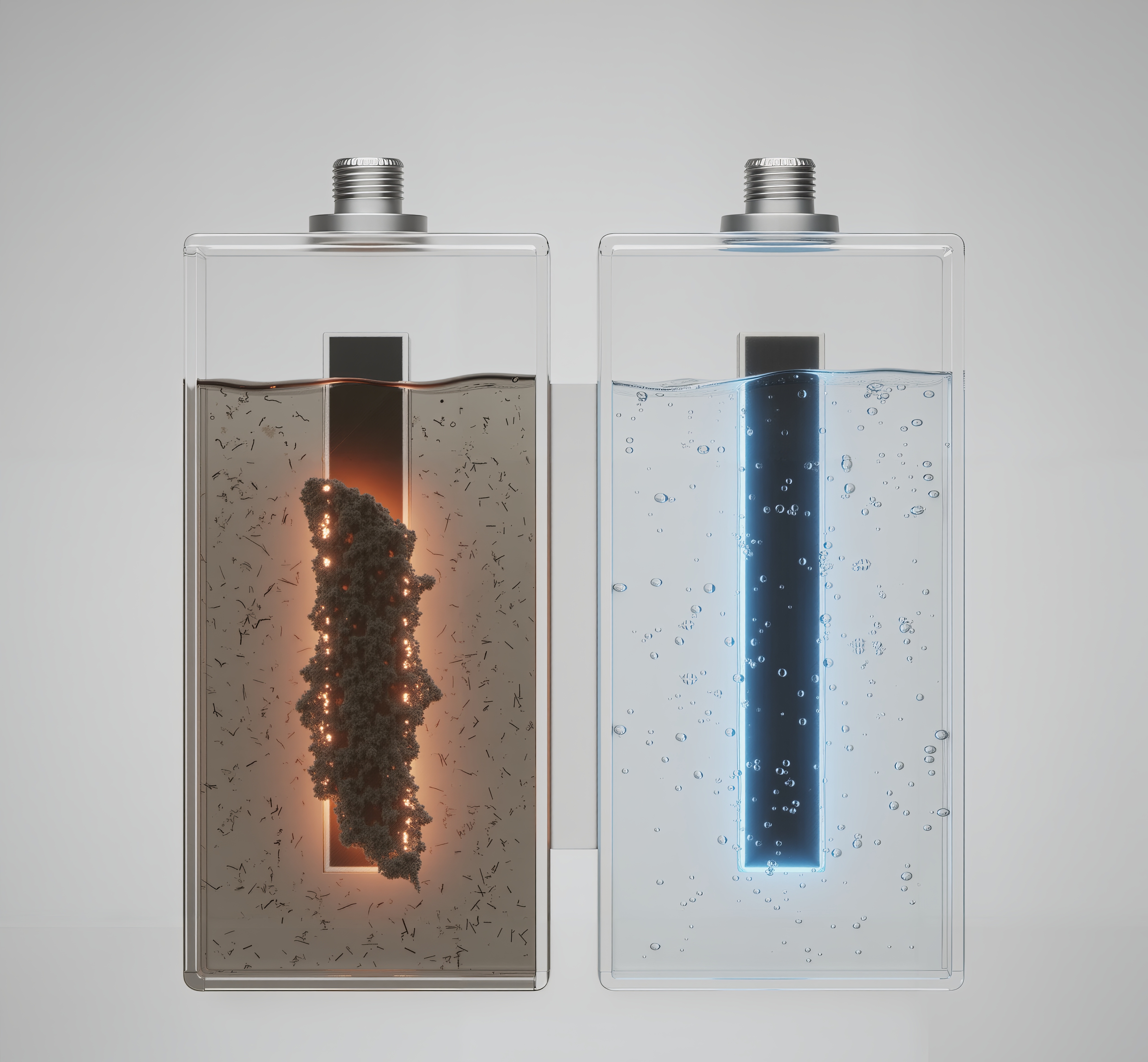 The end products of the process are benign salts that can be safely disposed of or discharged. Source: i-element/Adobe Stock
Central to this technology are boron doped diamond electrodes, which are manufactured using microwave chemical vapor deposition. This creates a polycrystalline diamond surface capable of withstanding conditions under which conventional metal-based electrodes would fail. These free-standing electrodes measure between 0.3 millimeters and 2 millimeters in thickness and typically reach 130 millimeters to 140 millimeters in diameter, unlike thin-film alternatives that rely on metal substrates. This construction allows them to operate at extreme pH levels and handle current densities exceeding 2,000 amperes per square meter (A/m2), at times pushing as high as 30,000 A/m2 with similar or longer lifetimes than their thin-film counterparts.
Achieving such high current densities is critical, because it enables the destruction of short-chain PFAS compounds. The ZEO system offers a proven, scalable solution that can be deployed in the field to destroy even these stubborn four- and five-carbon PFAS compounds that other treatment methods frequently fail to remove.
How the process works
The ZEO system operates as a simple yet effective semi-batch process. PFAS concentrate is loaded into a circulation tank before being pumped across the boron doped diamond electrodes, where oxidation occurs. The treated liquid then returns to the tank. With each pass, long-chain PFAS compounds break apart, converting into either carbon dioxide, sodium fluoride or fractionally smaller PFAS compounds. The longer the process runs, the more oxidation occurs, eventually leaving only the smallest four- and five-carbon compounds.
Rather than continuing to complete oxidation, which is considered electrically inefficient, the system recirculates the partially oxidized mixture to the front of the PFAS separation process. The treated liquid combines with incoming PFAS entering the separation process for the first time, forming a concentrated PFAS stream for electro-oxidation treatment. Because of this configuration, the ZEO system always sees a very concentrated PFAS input stream, which helps maximize efficiency.
Demonstrated performance
This technology has been tested with landfill leachate, which is widely regarded as one of the most complex waste streams. Samples of foam fractionate from a landfill leachate (produced using a multistage foam fractionation system), underwent treatment using a ZEO pilot unit. The results were analyzed using EPA Draft Method 1633 and showed total PFAS reduction of 99.996% across 40 different PFAS compounds. This included nine proposed RCRA PFAS compounds. Most notably, substantial reductions in short-chain compounds such as PFBA and PFBS — compounds that typically survive other treatment methods — were also achieved.
 This technology has demonstrated its ability to oxidize compounds that are soluble in water as well as destroy suspended particles such as microplastics. Source: Emanual/Adobe Stock
Testing also revealed something important about the process economics. Electrochemical oxidation cells generally operate in two distinct regions that dictate the rate of the reaction and the efficiency of the system: the current-limited (or kinetic-limited) region and the mass-transport-limited (or diffusion-limited) region. To maintain optimal economics, the system must operate in the current-limited region, which requires PFAS concentrations above approximately 2,000 nanograms per liter. Within this region, energy consumption runs between 20 kWh/kg and 40 kWh/kg of chemical oxygen demand removed (i.e., it takes 20 kilowatt-hours to 40 kilowatt-hours of electricity to break down 1 kilogram of organic contaminants in the water).
It is important to note that while other thermal processes may use less energy, they fail to destroy all PFAS — especially short-chain compounds — unless they reach extreme conditions. These include temperatures above 370° C (698° F) with pressures above 300 bar (i.e., supercritical water oxidation), or temperatures of 1,400° C (2,552° F) through thermal incineration. Even when these conditions are met, achieving consistent destruction of short-chain PFAS remains a challenge.
Future applications
For landfills struggling to manage PFAS-contaminated leachate, the combination of foam fractionation with boron doped diamond electro-oxidation promises a highly effective and economically practical solution. The ZEO system’s modular design allows for scaling to fit specific application requirements. A single system can use up to four reactors, each with the capacity to destroy 2 kilograms per hour of compounds contributing to chemical oxygen demand. If an application requires more than 8 kilograms per hour of oxidation capacity, additional units can operate in parallel. Reactors can be added or removed during operation without shutting down the entire system, each with its own power supply and the ability to isolate for maintenance while the rest continue operating.
The end products of the process are benign salts that can be safely disposed of or discharged, including sodium carbonate, sodium fluoride and sodium sulfate. Beyond PFAS, this technology has demonstrated its ability to oxidize compounds that are soluble in water as well as destroy suspended particles such as microplastics.
Conclusion
As PFAS regulations continue to tighten globally, industries face the challenge of ending the cycle of contamination rather than simply moving it from one place to another. The Zimpro electro-oxidation (ZEO) process, with its ability to break the carbon-fluorine bonds that have long resisted conventional treatment, offers a commercially available, field-tested method for achieving this goal. This innovative technology has the potential to solve issues faced not only by water utilities worldwide but also by landfills managing contaminated leachate, industrial facilities treating complex wastewater and environmental/remediation organizations seeking a permanent end to PFAS contamination.

Electro-oxidation (EO) is an advanced water treatment technology that uses electricity to break down persistent pollutants like PFAS (“forever chemicals”) into harmless substances such as CO₂ and fluoride. Unlike traditional methods that only capture contaminants, EO can completely destroy them, making it a more effective and sustainable solution.
PU flooring and Epoxy flooring are not directly involved in PFAS destruction, but they can be used in EO or water treatment facilities:
�� So, PU and Epoxy flooring can be easily integrated into EO-based treatment plants to ensure a strong, safe, and long-lasting working surface.
In reply to #1
Electro-oxidation: A potential method for destruction of PFAS The electro-oxidation process aims at treating PFAS rather than just transferring the pollution to a different waste stream. This differentiates the process from PFAS treatment by adsorption (e.g., activated carbon or ion-exchange resin) in which the PFAS are captured on the media with the focus being on effectively managing or regenerating the media used.
The electrochemical process involves application of an electrical potential for reaction to occur at an electrode. This can lead to attack of PFAS molecules if the right conditions are set in terms of the water chemistry, electrode material and design and operating conditions (current density, mass transfer rate and competition with other organic and inorganic species), energy input and electrode stability.
In real wastewater, electro-oxidation is therefore usually combined with other steps for concentrates of PFAS (or wastewaters) to show complete mineralization of the PFAS and evaluate reduction of transformation products rather than simply achieving a certain percentage reduction in PFAS.