
Cold air battery rises in the desert
S. Himmelstein | January 16, 2026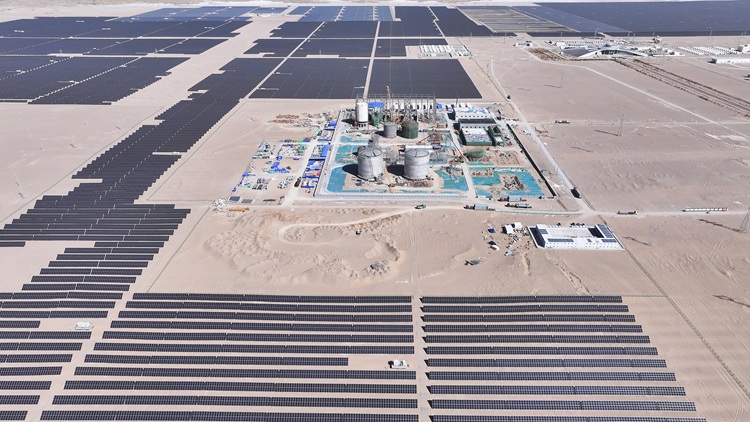 Source: Visual China Group
Construction of the world’s largest super-cold air battery, initiated in 2023, is nearing completion in the Gobi Desert of China. The Qinghai 60,000 kW/600,000 kWh liquid air energy storage demonstration project, built by China Green Development Investment Group, has entered its final commissioning stage.
The Super Air Power Bank can run continuously for 10 hours, generating some 180 million kWh annually — sufficient to power around 30,000 homes every year. The facility will be instrumental in balancing the fluctuations of renewable energy sources, and a 250,000-kW photovoltaic project will play a supporting role in affording the system sustainable, self-supplied charging capability.
The plant works by compressing and cooling air to -194° C before liquefying and storing it in specialized tanks. When released, this liquid expands over 750 times, driving turbines to generate electricity. The technology essentially transforms air into an energy storage carrier under extreme cold.
During off-peak hours, excess electricity powers compressors to pressurize purified air into high-pressure, high-temperature gas. This gas is then cooled and liquefied in a cold box before being stored in low-temperature atmospheric-pressure tanks. The heat generated during compression is captured in high-pressure spherical tanks. Under peak electricity demand conditions, the liquefied air is pressurized and vaporized. Assisted by both the recovered heat and cold-storage medium, it forms high-pressure, high-temperature gas that drives expanders to generate electricity.




It would be interesting to see what the nett round-trip efficiency of this complex system is, as well as the annual maintenance cost /MWh or MW.
In reply to #1
Oh why do you ask such practical questions...you are supposed to be supporting this green energy fantasy that everybody seems to have...
In reply to #1
Hi gideon, you might find some of your answers here
A giant 'Air Battery' emerges in the Gobi Desert - CGTN
This is entirely possible using Adiabatic heating and cooling in combination with conduction heat transfer to turn ambient heat into mechanical motion, with COLD as it's only "waste product". It was first demonstrated in California as the Water Powered Car in 1929. Here is my article explaining it's operating principles:
https://www.facebook