Small cost, big results with passive wastewater sampler
S. Himmelstein | January 15, 2026Sampling equipment engineered to detect biological contaminants in wastewater can incur costs up to $25,000, keeping such systems for protecting public health out of the reach of resource-limited communities. A low-cost remedy that can expand water testing capabilities in these areas has been designed by researchers from Louisiana State University and the University of Waterloo, Canada.
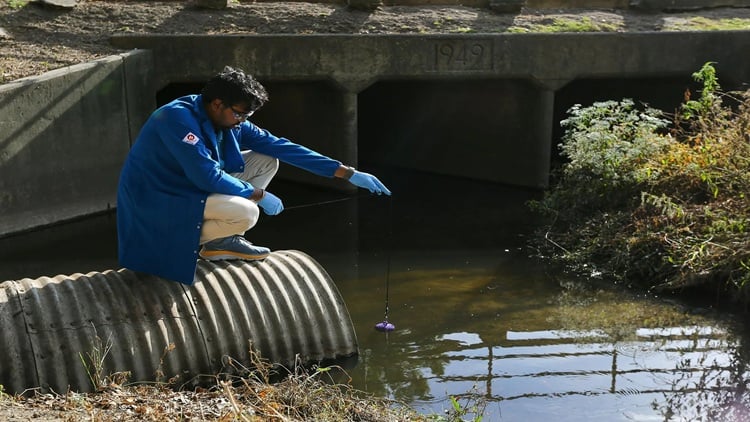 The sampler can be anchored on a string and tossed into a sewage line. Source: Louisiana State University
The 3D-printed passive water sampler uses activated charcoal pellets to capture microorganisms from water for testing and costs a mere $4. Anchored on a string, the device can be tossed into a sewage line to capture its biological samples. While submerged, granular activated carbon passively absorbs microorganisms, after which analysts retrieve the sampler, wash off the microbes and test the resulting solution.
A three-month study tested the utility of 38 passive samplers at a small wastewater treatment facility serving 4,500 residents in Louisiana. As reported in Water Research, this deployment enabled researchers to detect the genetic material of viruses, including SARS-CoV-2 and Respiratory Syncytial Virus (RSV), and bacteria that cause illness. Genetic material that renders bacteria resistant to certain antibiotics was also identified. The rate at which the sampler absorbs microbes was demonstrated to be mathematically predictable, indicating that this low-cost approach to wastewater-based epidemiology can yield quantitative data for public health surveillance from wastewater.