Researchers develop quick-setting, sustainable material to replace concrete in 3D printing
Marie Donlon | December 20, 2025A team of researchers at Oregon State University created a quick-setting, environmentally friendly alternative to concrete that could potentially be used to quickly 3D print homes and infrastructure.
The team sought to develop an alternative to concrete because cement, which is the binding agent in concrete, constitutes roughly 8% of the Earth’s carbon dioxide emissions. Further limiting is that concrete's curing time can take multiple days, thus inhibiting progress on construction projects.
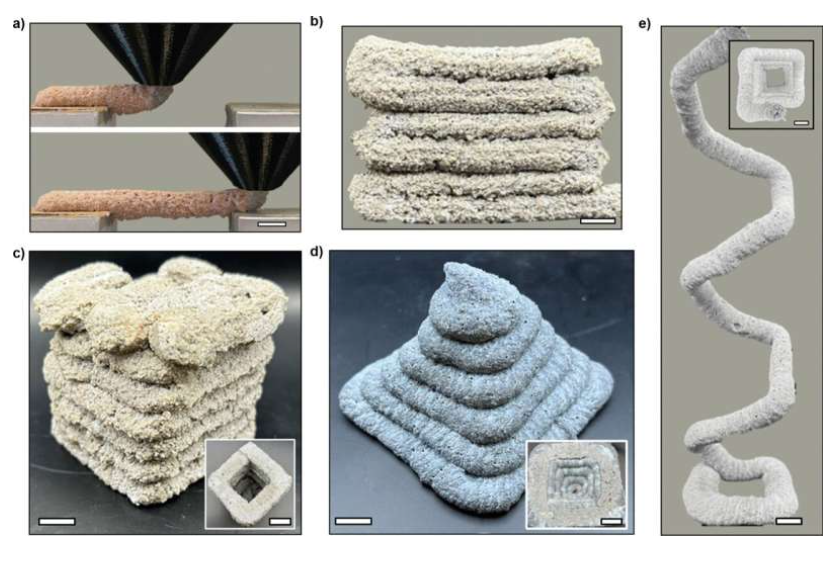 Source: Advanced Composites and Hybrid Materials (2025). DOI: 10.1007/s42114-025-01456-1
As such, the team developed a new clay-based material that cures as it is extruded from the printer. This is due to an acrylamide-based binding agent that experiences a chemical reaction called frontal polymerization. The material can also be printed across unsupported gaps — for instance, the top edge of an opening for a door or window.
"The printed material has a buildable strength of 3 megapascals immediately after printing, enabling the construction of multilayer walls and freestanding overhangs like roofs," explained the researchers. "It surpasses 17 megapascals, the strength required of residential structural concrete, in just three days, compared to as long as 28 days for traditional cement-based concrete."
Making the environmental footprint of this material smaller than that of concrete is that it is comprised mostly of soil infused with hemp fibers, sand and biochar — which is carbon-rich matter produced by heating wood chips and other organic biomass under low oxygen. Conversely, concrete's binder, cement, is manufactured from carbon-releasing reactions in industrial kilns heated to more than 1,400° C — generally using energy produced by the burning of fossil fuels.
For now, the new material is more expensive than standard cement-based concrete, but the team is working to reduce the price. Likewise, the developers will also have to follow American Society for Testing and Materials standard tests and prepare a report for professional engineers to review and approve before it can be used in construction projects.
An article detailing the work, “3D printing of sustainable infrastructure using rapid-set clay concrete with biobased additives,” appears in the journal Advanced Composites and Hybrid Materials.