Here’s how to bring additive manufacturing tooling in-house
September 19, 2025Developing appropriate tooling is often a major challenge. Typically, the product and jig designs are completed first and then sent to a tooling manufacturer. From there, the wait begins — sometimes lasting weeks or even months. By the time the new jig arrives, it is possible that the product design has changed, making the jig incompatible with the updated design. Even in the best-case scenario, the cost and waiting for tooling to arrive cuts into already tight margins and timetables.
To combat these problems, many manufacturers are turning to building jigs in-house instead of outsourcing this mission-critical step. This allows for a much shorter lead time and product design changes can be implemented much quicker. Bringing this operation in-house has never been easier than with the advent of additive manufacturing.
Using additive manufacturing for tool and jig development has the potential to save both time and money, without restricting new product designs. Once engineers have assessed the size, materials and quantity of printed tooling required by the facility, the printer is configured, and tool design files are sent to the printer instead of to outside agencies. From there, new tooling can be designed and manufactured quickly.
Investing in additive manufacturing for tooling
The decision to use additive manufacturing to build tooling in-house does not have to be complicated. First, plant engineers should characterize their tooling needs by tracking the size, materials and usage of the current tooling. They should make a list of the quantities, materials, maximum jig size and other such factors that will help them determine which printing is the best fit for their operations.
Desktop printing versus large format printing
When additive manufacturing or 3D printing is mentioned, many tend to think of small desktop printers for hobbyists or small prototyping concerns. Small desktop printers fit these roles but have some limitations, such as smaller print volumes, limited material choices and slow print speeds. Also, chamber temperature control is more challenging with a desktop printer, limiting design possibilities.
BigRep makes several lines of large format printers, capable of printing much larger objects. The larger chamber also makes temperature control of the print easier and more precise. Small temperature fluctuations are less likely to impact print quality in a large chamber. To put it another way — frustrations experienced with desktop printing are not commonly experienced with large format printing.
Short lead times
One of the key advantages of additive manufacturing for tool and jig production is the short lead times. Instead of having to find quotes, talking to numerous machine shops and go back and forth about design features, jig designs can be sent directly to the printer. Once the print is completed, the engineers can determine whether the design is suitable for production. This whole process may only take a couple of hours or days, versus weeks of negotiating, manufacturing and testing of prototype jigs.
The short lead times are essential for replacement jigs as well. The failure of a specialty jig could mean a fully stopped production line under the wrong circumstances. The ability to print another jig in a few hours is a tremendous advantage. Lead times are further reduced by the fact that machines can be intelligently configured for “lights off” operation, and the user does not have to physically operate the printer.
Lower cost for design changes
Along with short lead times is the ease at which designs can be altered. Consider a product that needs to be altered based on customer feedback. If the custom tooling that was recently purchased for the first design was expensive, the temptation will be to use some of the jigs in the second product iteration.
The ability to build tooling in-house allows design engineers more freedom in their designs. Many “new” designs are based on what tooling is available, rather than what could be possible with new tooling. For example, historically, the diameter of the Saturn V rocket can be traced down to the tooling used for Roman chariots many years earlier.
Onshoring efforts
It can be difficult and time consuming to reach out to tooling shops overseas. Time zone differences, shifting geopolitical landscapes and long transit times can drastically impact the lead time on new tooling. There are advantages to “reshoring” or bringing the manufacturing efforts back into one’s home country. Instead of sending files overseas, they can send them to the large format printer in the manufacturing facility and begin testing immediately.
As companies eye their environmental, social and governance (ESG) goals, the ability to trace the entire supply chain is essential. When tooling is brought in-house, it is also less likely that intellectual property can be copied. Furthermore, there is less of a concern for tooling to be reverse engineered and to reduce exposure to violating trade protocols (such as ITAR for defense-related products).
Additive manufacturing put to the test
How does additive manufacturing of tooling actually impact business needs? Reduction in cost, fewer bottlenecks and the ability to make changes quickly top the list of advantages. In these case studies, companies noticed an improvement in all of these areas, plus others.
Ford’s German manufacturing facility
Ford has extensive demands for tooling, particularly for clamps and fixtures to hold heavy parts in place during welding. These fixtures required numerous manual machining steps and had lead times in the multiple-week range. They required around 190 separate fixtures to perform one completed part.
In more recent years, they partnered with BigRep, purchasing their BigRep ONE and BigRep PRO large format printers. Instead of having to machine all of these clamps by hand, they can now print the clamps overnight. Their workflow was drastically simplified, and their throughput increased significantly.
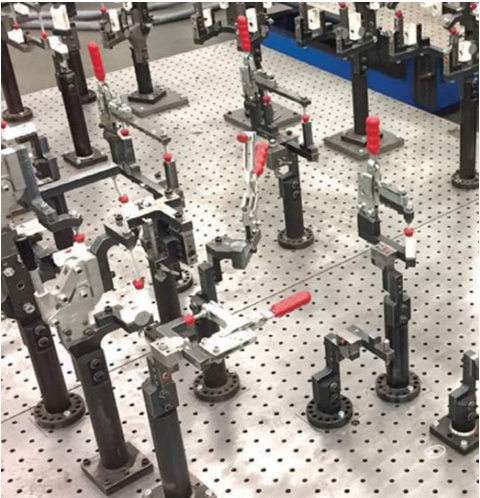 Figure 1. Fixtures for a welding process in Ford's German manufacturing plant. Source: BigRep
They also found that some of their jigs, which often required eight to ten weeks of lead time, can be manufactured in two to three days instead. These jigs were designed to help with alignment of components and make mock-ups and templates of parts to ensure clearance and fit during installation and use.
Ultimately, the use of in-house additive manufacturing decreased lead times by 94%, and Ford benefitted significantly from simply moving tooling in-house.
LEGACY MOTOR CLUB
LEGACY MOTOR CLUB is an auto racing organization heavily involved in NASCAR races, with multiple cars and drivers in the races. As such, they are in constant need of high-quality components that can be sourced and installed quickly. In the past, some of these components have had multiple-week-long lead times from machine shops using traditional manufacturing techniques.
Items such as the gear cooler plenum were running for roughly $2,000 a piece, with a week-long lead time. However, when BigRep assisted LEGACY MOTOR CLUB in starting to print their own parts, the cost of the gear cooler plenum dropped to $56.93 per part, all with a reduced lead time. Considering LEGACY MOTOR CLUB needed about 20 of these per race season, the savings were significant.
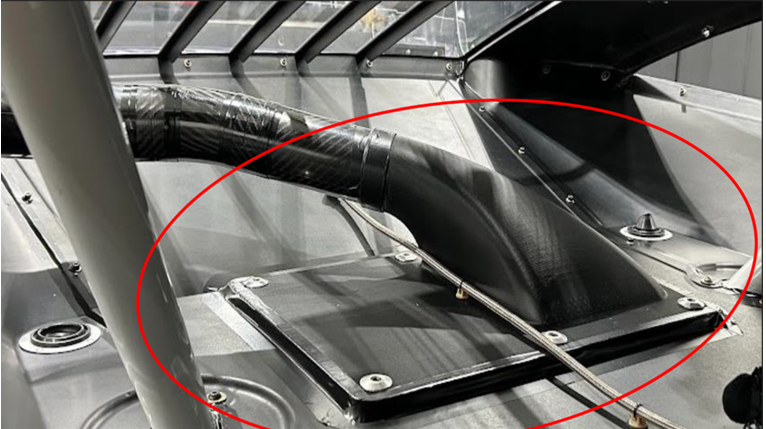 Figure 2. Gear cooler plenum circled in red. In-house printing saves approximately 97% of the cost, with a reduced lead time as well. Source: BigRep
Besides these parts, LEGACY MOTOR CLUB found savings in both time and cost by printing the layup molds for producing the carbon fiber grill bezels, rocker extension skirts (to keep the car from flipping over if it spins out) and other components. Every one of these savings was realized through printing in-house instead of outsourcing parts.
Machine options for production
BigRep has developed several additive manufacturing products to serve automotive, aerospace, defense, oil and gas production and many other industries. Each large format, production-scale printer has a unique set of features, print size and compatible materials, making it possible for engineers to choose the best fit for their additive manufacturing needs.
Engineered for continuous, industrial production, part-to-part variation is minimized and intuitive controls and indicators mean operators can be trained to use these machines quickly. Circulating fans in the chamber ensure uniform heating, enhancing print integrity throughout the process.
VIIO 250
The VIIO 250 is designed to make very large, high-resolution parts, with a maximum build volume of 250 L. The build chamber measures 1,000 mm x 500 mm x 500 mm and is temperature controlled, with a maximum build chamber temperature of 50° C. Three nozzle sizes (0.4 mm, 0.6 mm and 1.0 mm) and an extrusion temperature of 350° C make this printer suitable for many materials, including those used in making carbon-fiber composites.
Geared towards ease of operation, the VIIO 250 is ideal for research and development labs, university settings and product development ventures. The machine can handle up to 32 kg of materials, which make it ideal for automation or “lights out” manufacturing uses.
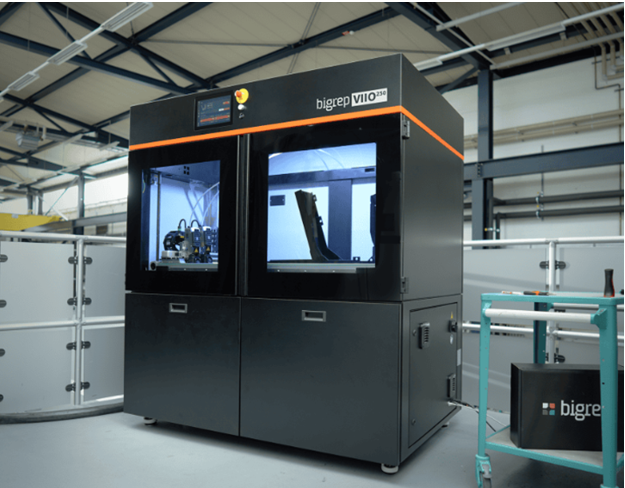 Figure 3. The VIIO 250. Source: BigRep
ALTRA 280
The ALTRA 280 features four state-of-the-art, water-cooled extruders that can be heated to 450° C. The four-nozzle design means prints will be uninterruptable; if one nozzle has a problem, another kicks in and finishes the print. This feature is especially valuable for high-value, large prints, where an interrupted print might mean a scrapped part. With a 280 L build volume (500 mm x 700 mm x 800 mm), which can be heated to up to 180° C, this is the printer for high performance, high temperature materials. The ALTRA 280 is designed for production of aerospace components, defense and military equipment, medical devices and other general manufacturing needs.
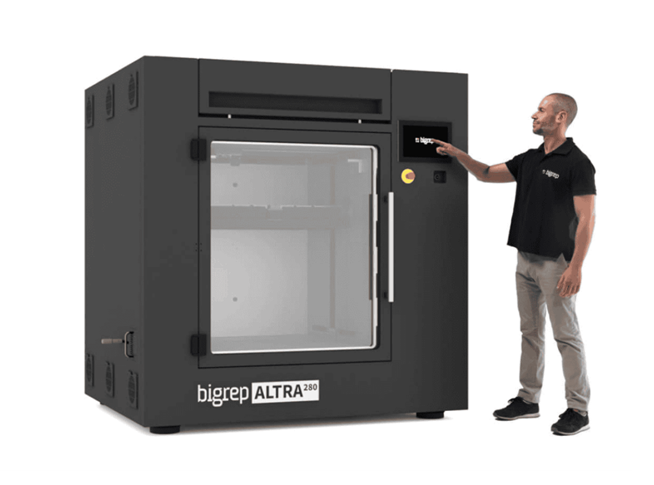 Figure 4. The ALTRA 280. Source: BigRep
IPSO 105
The IPSO 105 represents a tradeoff between size and cost. Featuring two of the state-of-the-art DSX extruders found on the ALTRA 280, and a build area of 400 mm x 600 mm x 400 mm, it is geared for the in-house tooling production. A smaller volume with no sacrifice to build quality, the IPSO 105 is a way to transition from desktop printers into the world of large format, production-scale additive manufacturing.
The machine is made for the shop floor and has a heated chamber of up to 100° C, and a nozzle temperature of up to 450° C, making it suitable for a wide range of engineering-grade thermoplastics, such as acrylonitrile butadiene styrene (ABS), polycarbonate (PC) thermoplastic polyurethane (TPU) and various nylon (PA) formulations. The IPSO 105 is built for high precision. In addition to aerospace, military and medical device markets, it is also suitable for electronics manufacturing.
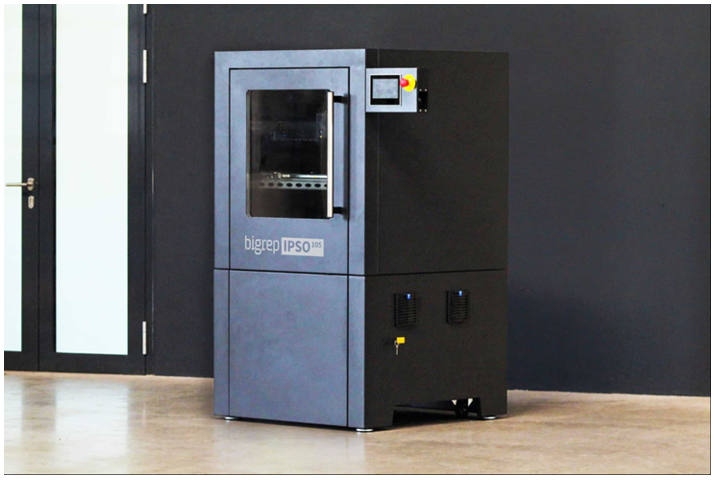 Figure 5. IPSO 105. Source: BigRep
In terms of choice in printing materials, these three printers can handle a wide range of engineering-grade polymers. The chart below highlights the choice in materials available for each printer.
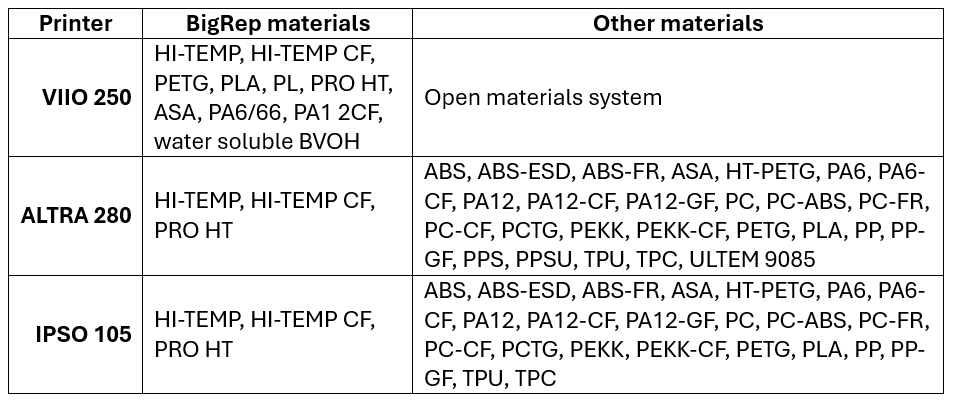 Table 1. Materials selection by printer. Data source: BigRep
The BigRep advantage
BigRep has been serving numerous industries in their additive manufacturing needs for over a decade. They help users bring tooling in-house to reduce lead times and cost, which thus allows customers to keep up with competitive manufacturing markets.
It is crucial to work with specialists who can help create a list of “whys” and “hows” to determine which BigRep printer is the best fit for your specifications. To get a benchmark part printed for validation, or to learn more about how additive manufacturing can benefit any tool or jig development, reach out to the experts at BigRep today.