Recycled tires boost railway track strength while cutting waste
Marie Donlon | August 22, 2025Researchers from the University of Technology Sydney (UTS), Sydney Trains, Transport for NSW and industry partners EcoFlex and Bridgestone have demonstrated that a system of rubber shock absorbers derived from recycled tires protect railway tracks from damage.
To confirm the effectiveness of these tire-derived rubber shock absorbers, the team installed track sections with the rubber underlay alongside conventional track sections at a live Sydney Trains freight line for a direct comparison. Once installed, the team monitored vibration, track settlement and ballast degradation under real-world conditions.
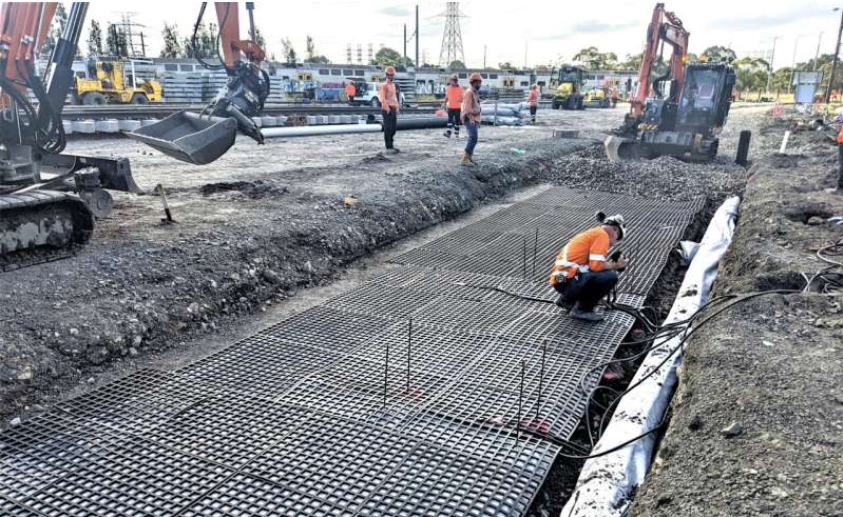 The recycled rubber grids on a stretch of test track laid at Chullora NSW. Source: Rakesh Malisetty.
Following this assessment, the team discovered that the sections with the rubber underlay were significantly less degraded.
To create the absorbers, the team used patented technology that involves placing the tire cells in a strategic layout composed of recycled tires infilled with waste materials such as spent ballast and coal wash. Additionally, recycled rubber grids cast from worn conveyor belts used at mining sites were also placed directly underneath the rail track's primary load-bearing layer, otherwise known as ballast.
"The rubber-based underlay effectively protects the ballast, preventing it from being pulverized and extending the life of the entire track structure. Additionally, the underlay controls the way the train load is distributed to the deeper, softer and often wet soil beneath the track, preventing unacceptable soil settlement and weakening of the overlying track. This translates directly to lower maintenance costs, fewer track closures for the public, and improved network reliability,” the researchers explained.
"If widely adopted by railway asset owners, this will save the Australian rail industry millions of dollars annually by reducing the demand for freshly quarried rock for ballast that is very expensive and not carbon friendly," the researchers concluded.
An article detailing the material, “Effects of rubber-intermixed ballast on train loading response through field monitoring in Western Sydney,” appears in the journal Canadian Geotechnical Journal.