Modified membrane fine-tunes oil fractionation
S. Himmelstein | July 01, 2025The production of gasoline, diesel and other petroleum products from crude oil is energy-intensive relying on heat to separate the components by their boiling point. The energy requirements for these fractionation processes can be reduced by means of a membrane designed to filter the components of crude oil by their molecular size.
The thin film filtration membrane engineered by researchers from MIT and King Abdullah University of Science and Technology (Saudi Arabia) efficiently separates heavy and light components from oil. It is also resistant to the swelling that tends to occur with other types of oil separation membranes.
Filtration membranes developed to date for this purpose have focused on polymers of intrinsic microporosity, which allow for the fast transport of hydrocarbons. However, they tend to excessively absorb some of the organic compounds as they pass through the membrane, leading the film to swell, which impairs its size-sieving ability.
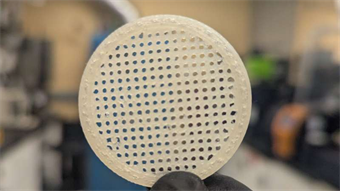
The researchers modified polymers that are used for reverse osmosis water desalination in order to improve the process. The polyamide thin film selected was altered by changing the bond that connects the monomers from an amide bond to an imine bond. A triptycene monomer was also introduced to enable the resultant polyimines to form pores of the right size for hydrocarbons to fit through. Hydrocarbons can The membrane filters crude oil components by their molecular size, an advance that could dramatically reduce the amount of energy needed for crude oil fractionation. Source: MIT quickly move through the membrane without causing noticeable swelling of the film compared to the original polyamide counterpart.
When applied to the filtration of a mixture of toluene and triisopropylbenzene as a benchmark for evaluating separation performance, the modified membrane described in the journal Science achieved a concentration of toluene 20 times greater than its concentration in the original mixture. The membrane also effectively separated the heavier and lighter compounds in a mixture consisting of naphtha, kerosene and diesel by their molecular size.