
Artificial surfaces use spikes, not chemicals, to destroy viruses
Marie Donlon | February 12, 2024An artificial surface manufactured by researchers from Spain’s University of Rovira i Virgili and Australia’s RMIT University promises to mitigate the infectious potential of viruses by puncturing them with tiny spikes.
The artificial surface is composed of silicon and reportedly features a series of tiny spikes that can damage the structure of viruses on contact, according to its developers.
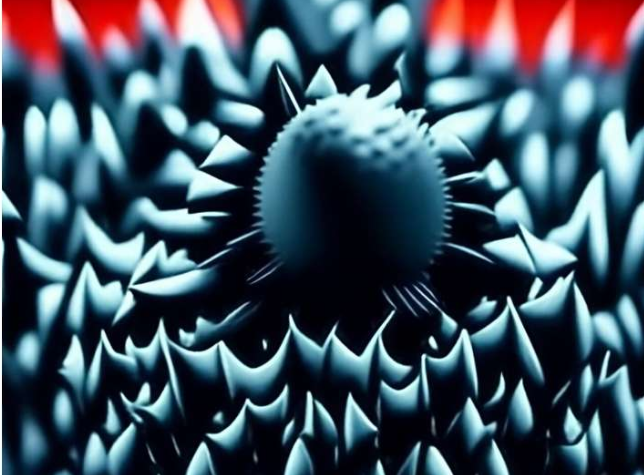 A virus on a nanostructured surface. Source: ACS Nano
Calling such processes 96% effective, the researchers suggest that artificial spiked surfaces could be used in environments featuring potentially dangerous biological material — such as laboratories — thereby making them easier to control and safer for the professionals working there.
Although simple in theory, using spikes to kill viruses promises high virucidal potential without having to use chemicals, the researchers explained.
To create the virucidal surface, researchers first used a smooth metal plate that was subsequently bombarded with ions for strategically removing material. The end result of this was reportedly a surface covered in 2 nm thick needles.
In the lab, the spiked surfaces incapacitated roughly 96% of the viruses it came into contact with during a six-hour period, wherein the needles destroyed the external structure of the viruses.
Such surfaces could be used in risky environments — in laboratories or health centers for instance — where they could potentially contain infectious diseases, thereby improving the safety of these environments and protecting those working in them.
The artificial surfaces are detailed in the article, "Piercing of the Human Parainfluenza Virus by Nanostructured Surfaces," which appears in the journal ACS Nano.
Durability of the spikes to oxidation, cleaning, abrasion?