Revised EASA Standard for Rotating Electrical Equipment Repair
Engineering360 News Desk | February 22, 2016The Electrical Apparatus Service Association has updated its document, “Recommended Practice for the Repair of Rotating Electrical Apparatus.” Aimed at supporting the work of electrical-equipment maintenance technicians, the update, designated as ANSI/EASA AR100-2015, replaces the existing standard that had been in place since 2010.
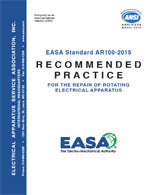 The revised standard is available through the IHS standards store. The document’s more than 90 changes include:
- A recommendation to indicate an authorization to ship for a completed repair.
- Changing the balance quality level for machines rated above 2500 RPM to level G1.0. Grade 2.5 still applies to machines rated 2500 RPM and below. This change, says the ANSI Technical Services Committee, affects service centers in the EASA Accreditation Program or that are considering accreditation.
- Added temperature limits of 700 F for cores with organic coreplate, and 750 F for inorganic coreplate.
- Changed evaluation criteria for bearing insulation testing, noting that there is no industry consensus for bearing insulation in motors supplied by variable-frequency drives.
- The requirement to perform winding resistance, insulation and surge tests on every repair; these tests were previously optional.
- The requirement for motors to be secured on a base plate or on a resilient pad for the no-load test. Also, the committee added recommendations for testing AC and DC motors that operate at above base speed.
- Unfiltered vibration limits were revised to conform to current NEMA and IEC standards values.
Powered by CR4, the Engineering Community
Discussion – 0 comments
By posting a comment you confirm that you have read and accept our Posting Rules and Terms of Use.