Detecting fuel cell surface defects in real-time
S. Himmelstein | October 19, 2023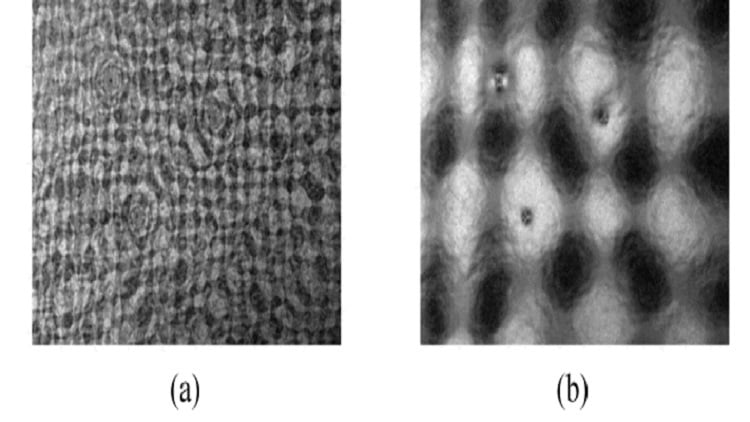 (a) High-carrier-frequency composite pattern. (b) Low-carrier-frequency composite pattern captured at the same area in (a). The pattern in (b) has much better fringe visibility than (a) and could be used to obtain the phase for surface measurement and defect detection. Source: IEEE Transactions on Industrial Electronics, vol.23, no.16, pp.7284, 2023.
The productivity and safety of hydrogen fuel cells improves with a process for the real-time detection of micro defects on the fuel cell surface during the production phase based on deep learning and enables real-time 3D measurement. The technology developed by Korea Research Institute of Standards and Science detects defects on the surface shape in a single shot by use of deep learning.
By enabling real-time 3D measurement, this deflectometry approach allows continuous monitoring of product quality without interrupting the manufacturing process. A deep learning network developed for this application was trained with measurement data on thousands of surface shapes. The result is a system that can perform real-time 3D morphology measurements of surfaces with low reflectivity or complex shapes.
For use with fuel cell samples, the algorithm was further trained using data on metal separators with surface defects. The 3D morphology measurement results shows that dents and scratches on the sample surfaces, which are difficult to be determined through conventional 2D inspection, are successfully detected in a single shot. The artificial intelligence algorithm was demonstrated to have acquired the application capabilities even with a small amount of data.
The deflectometry technology described in IEEE Transactions on Industrial Electronics can support real-time inspection of various faults and defects in fuel cell metal separators.