Electric eels spark droplet battery design
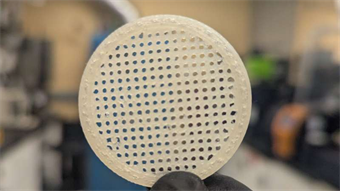
S. Himmelstein | November 09, 2023 Enlarged version of the droplet power source for visualization. Source: Yujia Zhang
University of Oxford, U.K., researchers have engineered a miniature power source for bio-integrated devices capable of altering the activity of cultured human nerve cells. The droplet battery uses internal ion gradients to generate power in a mechanism inspired by the way that electric eels produce electricity.
The miniaturized soft power source is produced by depositing a chain of five nanoliter-sized droplets of a conductive hydrogel, mimicking the structure and function of the eel’s electric organ. The droplets are separated by lipid bilayers, and each differs in composition, enabling a salt concentration gradient to evolve across the chain.
Cooling the structure to 4° C and changing the surrounding medium disrupts the lipid bilayers and causes the droplets to form a continuous hydrogel. The ions then move through the conductive hydrogel, from the high-salt droplets at the two ends to the low-salt droplet in the middle. The end droplets are connected to electrodes to enable transformation of the energy released from the ion gradients into electricity to power external components.
As reported in the journal Nature, the activated droplet power source produced a current, which was sustained for over 30 minutes. The maximum output power of a unit composed of 50 nanoliter droplets was around 65 nanowatts. The device was also attached to droplets containing human neural progenitor cells, which had been stained with a fluorescent dye to indicate their activity. When the power source activated, time-lapse recording demonstrated waves of intercellular calcium signaling in the neurons, induced by the local ionic current.
The droplet battery is envisioned to power next-generation wearable devices, bio-hybrid interfaces, implants, synthetic tissues and microrobots.