ORNL team develops camera system that detects building air leaks in real-time
Marie Donlon | September 30, 2023A system that uses a camera to detect air leaks from buildings in real-time has been developed by scientists from the U.S. Department of Energy’s U.S. Oak Ridge National Laboratory (ORNL).
While current methods for identifying and subsequently sealing any openings from which air is escaping — which indicates a loss of energy efficiency, and consequently leads to higher utility expenses for homeowners — can be costly, time-intensive and inconvenient, the ORNL team devised a new method for detecting such leaks in real-time.
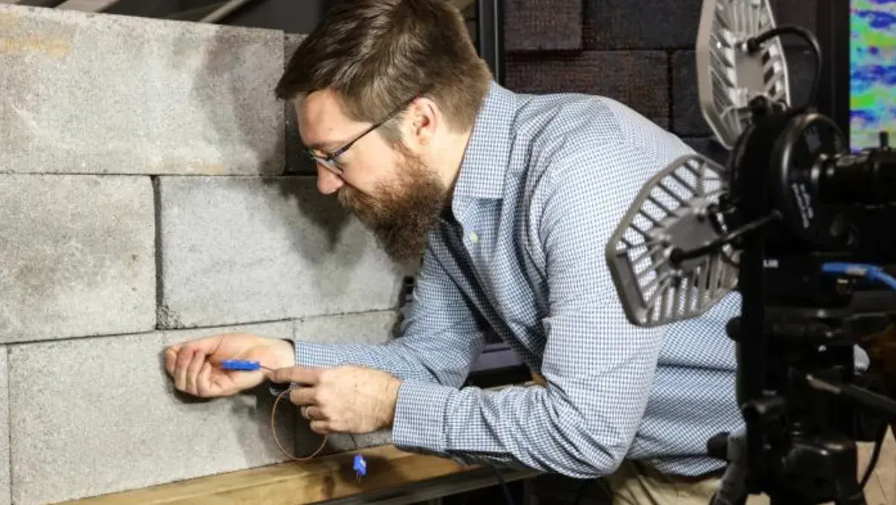 Source: ORNL
According to the researchers, the new method is actually based on an 1860s method called "schlieren photography" — a fluid flow capturing mechanism.
The researchers explain that this technique is often used for visualizing airflow surrounding aeronautical items by observing small changes in the backdrop of photographs. Through this method, users can reportedly identify air leaks via the different temperatures than the surrounding air. When held up against the façade of a structure, the temperature differential creates a sort of mirage, according to the researchers.
“Even though this mirage is too small to be seen with the naked eye, it can be imaged by a camera. The mirage looks just like wavy patterns you might see rising up from the pavement on a hot day or in the hot exhaust of a car tailpipe,” the ORNL team explained.
The ORNL team has also been developing custom software for real-time visualization of the leak along with algorithms for measuring both velocity and flow rate. This is expected to help users locate and prioritize those locations in most need of sealing, thereby saving both time and energy.
To test this approach, the ORNL team used the technique to visualize leaks in three cladding materials — brick, vinyl siding and concrete masonry blocks — under various lighting conditions.
According to their findings, leaks could be identified when the temperature differential on the concrete block and brick claddings was 54° F to 59° F.