Thirsty data centers gulp water at a record pace
S. Himmelstein | September 19, 2023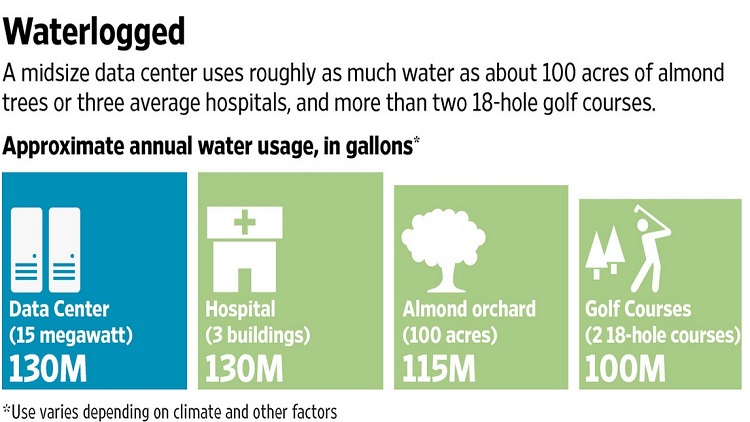 Source: California Department of Water Resources/U.S. Department of Energy/Wall Street Journal
The expansion of the data center sector in the U.S. and elsewhere has shed light on the enormous energy appetite of these facilities, which consume about 70 billion kWh of electricity annually in the U.S. — close to 2% of the nation’s electricity use. Such demand continues to surge as the use of applications such as artificial intelligence (AI), the internet of things and virtual reality grows. Coincident with this rise in energy use is an increase in water consumption, as evidenced by recent trends reported by internet giant Google.
The company consumed 5.6 billion gallons of water in 2022. Of this total, 5.2 billion gallons was used for data centers, representing a 20% increase over the volume reported in the previous year. This rise in water consumption is roughly in line with the increase in Google's compute capacity, which has been largely driven by AI. The increase also underscores the environmental cost of running huge data centers, which often require vast amounts of water for cooling purposes. The amount of water consumed in this sector will likely keep rising as tech companies engage in the AI development race and construct new data centers.
Google has targeted 2030 as a deadline to replenish 120% of the freshwater it consumes across its offices and data centers. Currently just 6% is being replenished, and most of the water resource being exploited is considered potable. Efforts to slake the thirst for freshwater resources include increased use of reclaimed and recycled water, installation of water-efficient fixtures, and use of rainwater capture and recovery systems. Greater reliance on ground-source heat pump technology is also expected to nearly eliminate the need to operate cooling towers and drastically cut water demand for cooling applications.
Amazon claims to be the first data center operator approved for using recycled water for direct evaporative cooling. Deployed in their data centers in northern Virginia and Oregon, they also have plans to retrofit facilities in northern California.
Microsoft’s Project Natick is a different attempt to tackle this challenge by submerging a sealed data center under water. Tests concluded off the Orkney Islands in 2020 showed that 864 servers could run reliably for two years with cooling provided by the ambient sea temperature, and electricity from local renewable sources.
Learn about sustainable water resource solutions with a free subscription to the Water & Wastewater Systems newsletter from GlobalSpec.