3D printed wall can communicate with its developers
Marie Donlon | July 26, 2023Researchers from the University of Cambridge in the U.K. have 3D-printed a so-called smart wall that can potentially make infrastructure safer and more sustainable.
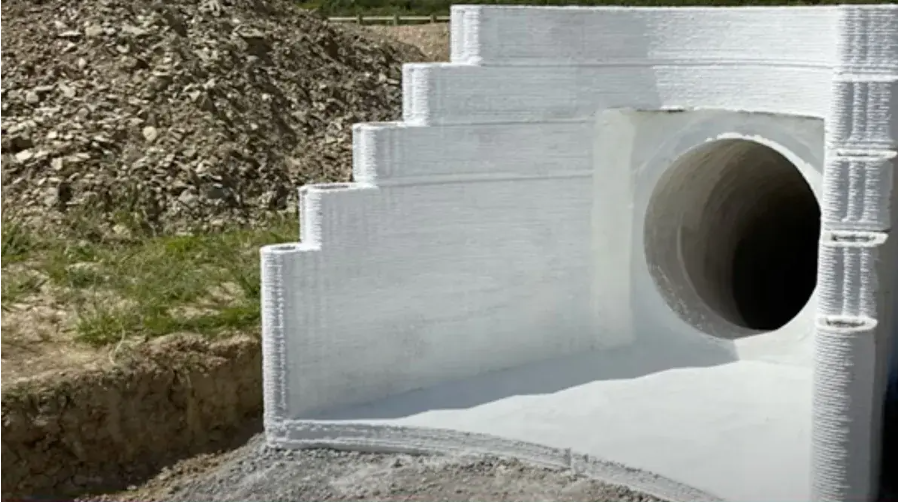
The researchers printed a retaining wall, otherwise known as a headwall, that offers real-time information via embedded sensors.
 Source: University of Cambridge
According to the smart wall’s developers, the sensors provide real-time data about temperature, strain, relative humidity, pressure, electrical resistivity and electrochemical potential — metrics that could potentially aid researchers in both detecting and correcting structural flaws before they occur.
The researchers suggest that 3D-printed digital walls promise to help them better understand such structures.
The 2 m high and 3.5 m wide wall, which is currently installed on the A30 roadway in Cornwall, U.K., took one hour to print via a robotic arm-based concrete printer. The researchers suggest that 3D printing the wall saved money, materials and carbon emissions.
Further, the team also employed lidar — light detection and ranging technology — to scan the wall during printing to create a 3D point cloud and subsequently a digital twin of the wall.
Meanwhile, the team also created a Piezoceramic Lead-Zirconate-Titanate (PZT) sensor for measuring electromechanical impedance response and tracking data changes over time so as to identify potential damage. The researchers explain that the smart sensors can demonstrate how 3D-printed mortar hardens over time.
"Eight PZT sensors were embedded within the wall layers at different positions during the 3D printing process to capture the presence of loading and strain, both during the construction process and service life after field installation," the researchers explained.
The researchers also noted that the combination of sensor data and the digital twin will improve understanding among construction and infrastructure professionals about how 3D printing can be employed for printing larger cement-based materials.
For more information on the 3D-printed wall, watch the accompanying video that appears courtesy of the University of Cambridge.