Video: Bioremediation solution targets 1,4-dioxane in groundwater
S. Himmelstein | August 14, 2023A new bioremediation solution has been demonstrated to degrade 99% of 1,4-dioxane, a pervasive synthetic industrial chemical that is completely miscible in contaminated groundwater.
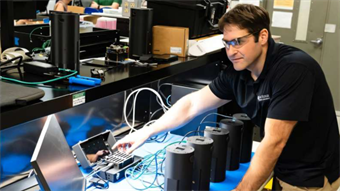
This chemical has been widely used for industrial chemical processes since the 1950s, and the U.S. Environmental Protection Agency lists it as one of the most prevalent emerging contaminants and a likely The 1,4 D-Stroy 18-liter stainless steel dispersion vessel. Source: Allonnia human carcinogen. While there are no federal regulations governing 1,4-dioxane levels in water, many states have established some degree of regulation or recommended guidelines and regulatory pressures are growing on a global scale.
The 1,4 D-Stroy treatment system developed by Boston-based Allonnia utilizes highly specialized microbes to provide a sustainable, low-cost and low-maintenance solution that feeds on 1,4-dioxane and breaks it down into water and carbon dioxide as the only byproducts. These bacterial agents were demonstrated in field tests to degrade 99% of 1,4-dioxane in contaminated groundwater from two contaminated wells in an 11-week time span.
In contrast to available commercial filtration systems or chemical removal platforms, 1,4 D-Stroy requires no capital investment and is delivered onsite via a portable, 18-liter, stainless steel dispersion vessel. The returnable system is designed to dose precise amounts of the microbes to the contaminated water, where they engage with 1,4-dioxane, ingest it and render it harmless.