Listening in on glacial melting
S. Himmelstein | July 06, 2023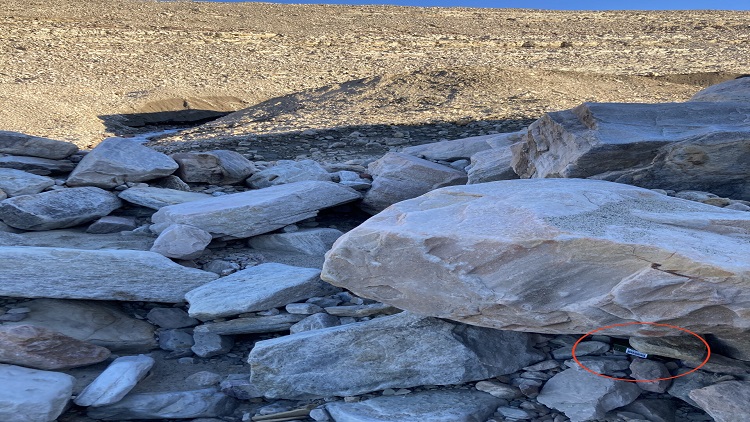 An acoustic sensor is deployed in a sheltered location (red circle) near the glacier to continuously record sounds. Source: Evgeny Podolskiy
Glacial retreat and melting must be monitored to gauge meltwater contributions to sea level rise and coastal flooding risk. Such monitoring is cost-intensive and can pose safety hazards for researchers, prompting scientists from Japan’s Hokkaido University to develop a more affordable and effective acoustics-based approach for measuring glacial discharge.
Recent research has linked infrasound signals to glacier runoff, marked by a daily variation and a peak during the summer. As these signals appear to be caused by the radiation of air-pressure waves from glacier runoff, the researchers proposed that discharge may be quantified by examining the audible sounds that are also generated by melting glaciers.
Field tests conducted at Qaanaaq Glacier, Greenland, demonstrated that acoustic noise levels scale with proglacial discharge, with an easy-to-detect, audible diurnal pattern. A commercially available bird-song recorder was deployed near the terminus of the glacier to document the ambient soundscape. The acoustic data was analyzed and cross-correlated with discharge trends to identify a frequency band as a proxy for the proglacial stream.
The highest correlation was observed in the frequency range of 50 Hz to 375 Hz. Noise levels were found to mimic the temporal variation in runoff, and the acoustic signal was recorded approximately 50 minutes before a corresponding change in discharge.
The study published in Geophysical Research Letters demonstrated that audible acoustic signals can be used for sensing glacio-hydrological variations remotely and continuously. This approach reduces the risk of instrument loss, does not require advanced data processing techniques and can be incorporated in early-warning systems to help mitigate glacial flooding events.