Solid air tech cools hydrogen transport costs
S. Himmelstein | May 26, 2023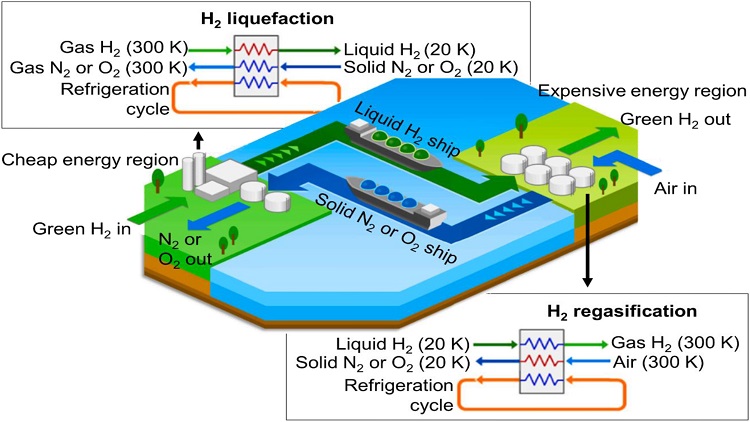 Schematic of the solid air hydrogen liquefaction process. Source: Hunt et al. (2023)
Continued growth of the hydrogen economy is impeded by fuel transportation challenges, as the liquefaction process used to facilitate oceanic transport is cost- and energy intensive. A new approach developed by an international research team proposes using solid air (nitrogen or oxygen) as a medium for recycling cooling energy across the hydrogen liquefaction supply chain.
Solid air hydrogen liquefaction technology stores the cooling energy from the regasification of hydrogen by solidifying air and transporting the solid air back to where the hydrogen was liquefied. The solid air is then used to reduce the energy consumption for liquefying hydrogen. The four steps involved in the process — hydrogen regasification, solid air transportation, hydrogen liquefaction, and liquid hydrogen transportation — are explained in a paper published in the International Journal of Hydrogen Energy.
Using solid air as a medium for recycling cooling energy across the hydrogen liquefaction supply chain can reduce the cost and energy consumption for transporting hydrogen between continents and thereby strengthen the viability of a global hydrogen economy. Solidifying air for energy recovery also yields oxygen that could be used to increase the efficiency of power generation with oxy-combustion and to facilitate carbon capture, use and storage.
Researchers from the International Institute of Applied Systems Analysis (Austria), Federal University of Rio Grande do Sul (Brazil), Chung-Ang University (Republic of Korea), Technical and Vocational University (Iran), Federal University of Espírito Santo (Brazil), Renmin University (China), Federal University of Rio de Janeiro (Brazil) and King Abdullah University of Science and Technology (Saudi Arabia) contributed to this development.