Report: Bringing modern manufacturing to hydropower
S. Himmelstein | May 08, 2023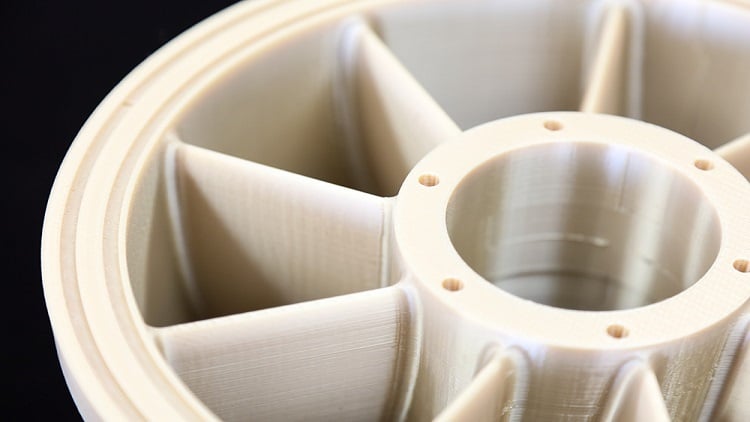 A newly manufactured fixed guide vane of a hydropower turbine system was printed at the DOE Manufacturing Demonstration Facility at ORNL. Source: Genevieve Martin/ORNL, DOE
The U.S. hydropower industry, contributing 30% of all renewable energy generation and 6.1% of the national energy portfolio in 2021, evolved by means of traditional manufacturing processes. U.S. Oak Ridge National Laboratory (ORNL) researchers maintain that the time is ripe to revamp manufacturing technology for this sector in response to supply chain impediments, surging energy demand and higher material costs.
Opportunities for advanced manufacturing and modernization of the hydropower fleet are highlighted in a report prepared by ORNL and scientists from GE Research, Kearns & West, and the U.S. Department of Energy (DOE) Water Power Technologies Office. Existing infrastructure challenges and ways in which advanced manufacturing could enhance new design capabilities, improve system and component performance, reduce reliance on foreign manufacturing and better address environmental concerns are identified.
Additive manufacturing can deliver diverse benefits, including design optimization and the ability to potentially manufacture parts on site, thus increasing accessibility to necessary parts. Embedded sensors, aeration, and cooling channels are some potential hydropower applications. Constructing parts layer by layer enables unconventional geometries and material configurations for hydropower components.
Hydropower facilities rely on large metal components, such as turbine blades and wicket gates, with unique geometries and material properties. These components require large casting processes that are primarily performed outside the U.S. Combining additive and subtractive techniques into a hybrid process can enable faster production and higher-quality parts by avoiding supply chain bottlenecks and reducing manual interaction.
The use of lower cost or higher performance alternatives for plant components is also recommended. Functionally graded materials could help optimize the surface and bulk properties of runners, and fiber-reinforced polymer composites could help reduce conveyance costs for new facilities. New coatings and application processes engineered to counter corrosion, cavitation and other common failure models can also be deployed to reduce toxicity and improve durability of conventional alternatives.