Tapping freshwater from oceanic water vapor
S. Himmelstein | December 26, 2022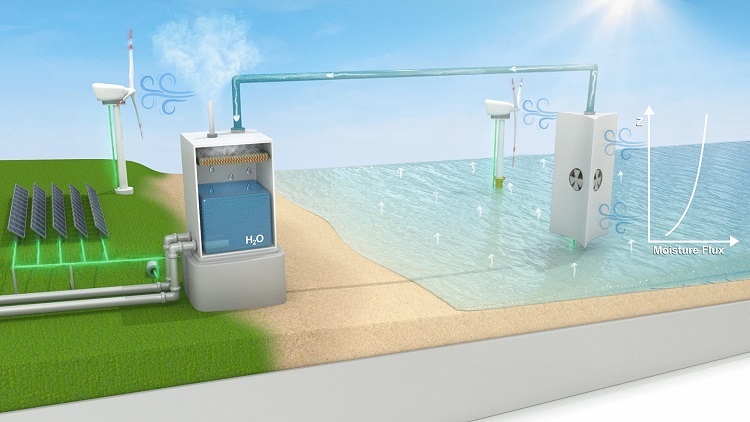 Schematic of the proposed approach for capturing moisture above the ocean surface and transporting it to proximal land for improving water security. Source: Praveen Kumar/Scientific Reports (Sci Rep) ISSN 2045-2322
An environmentally and economically sound alternative to conventional desalination to increase fresh water supplies is advocated by University of Illinois researchers. Water vapor from the atmosphere just above the ocean surface can be harvested and transported to proximal land, followed by its condensation to yield fresh water.
As this moisture in the atmosphere results from the natural evaporation of oceanic water, no environmentally harmful byproducts are produced or captured. The viability of the proposed approach was explored by computing the quantity of extractable moisture available in the near-surface atmospheric column above the ocean, based on data from water-stressed regions worldwide.
The analysis considered placement of hypothetical offshore structures 210 m wide and 100 m tall height to capture evaporated moisture flux in the form of water vapor in the atmosphere above the ocean. The system was estimated to provide a sufficient volume of extractable moisture to meet the daily potable needs of about 50,000 people in near-coastal population centers. The water can also be transported significant distances inland to meet or augment critical needs.
The research published in Nature Scientific Reports broadens opportunities for developing novel infrastructure that can effectively target the increasing global scarcity of fresh water.