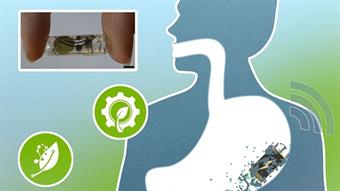
Watch how sweat powers this wearable battery
S. Himmelstein | August 23, 2021Human sweat is the electrolyte powering a soft, stretchable battery composed of non-toxic, sustainable materials by researchers from Nanyang Technological University (Singapore) and Wuhan University (China).
The wearable 2 cm x 2 cm unit designed to power watches, wrist bands or arm straps is synthesized by printing ink containing silver flakes and hydrophilic poly(urethane-acrylate) (HPUA), which function as the battery electrodes, onto a stretchable textile. As the silver flakes contact sweat, its chloride ions and acidity cause the flakes to clump together, increasing their ability to conduct electricity and facilitate the flow of electric current between the electrodes.
 Schematic of the enhanced conductivity from human sweat and the surface changes of the printed Ag-HPUA electrodes upon contact with sweat before and after stretching. Source: Pooi See Lee et al.
Resistance of the battery material is lowered as it is stretched, enabling its use when exposed to strain, such as when the user is exercising. The absorbent stretchable textile retains a lot of sweat, so that the battery remains powered even when the rate of sweating is inconsistent.
A test subject wearing the battery around their wrist and cycling on a stationary bicycle for 30 minutes was able to generate a voltage of 4.2 V and output power of 3.9 mW, sufficient to power a commercial temperature sensor device and send the data continuously to a smartphone via Bluetooth.
The research is published in Science Advances.