Novel thermometer expands opportunities in quantum computing and thermodynamics
Amy J. Born | July 13, 2021Coaxial cables and waveguides, key components in quantum computers, are the structures that connect the quantum processor and the electronics that control it. Microwave pulses reach the quantum processor via the waveguides and as they move along they are cooled to extremely low temperatures. The waveguides also attenuate and filter the pulses so that the quantum computer can work with stable quantum states.
Researchers must ensure that thermal motion of electrons is not adding noise on top of the pulses that are carried by the waveguides. To do this, the temperature of the electromagnetic fields is measured at the cold end of the microwave waveguides, where controlling pulses are delivered to the computer’s qubits. This is the point with the lowest possible temperatures and the least risk of introducing errors in the qubits.
Measuring the temperature has only been done indirectly and with a significant delay. A novel thermometer developed by researchers at Chalmers University of Technology, Sweden, and ETH Zurich, Switzerland, can simply and quickly measure temperature during quantum calculations with extremely high accuracy. Very low temperatures can be measured directly at the receiving end of the waveguide with extremely high time resolution.
The device is being used to measure a processor working temperature close to absolute zero, down to 10 millikelvin. The goal is to build a quantum computer by 2030 based on superconducting circuits with 100 or more well-functioning qubits performing correct calculations.
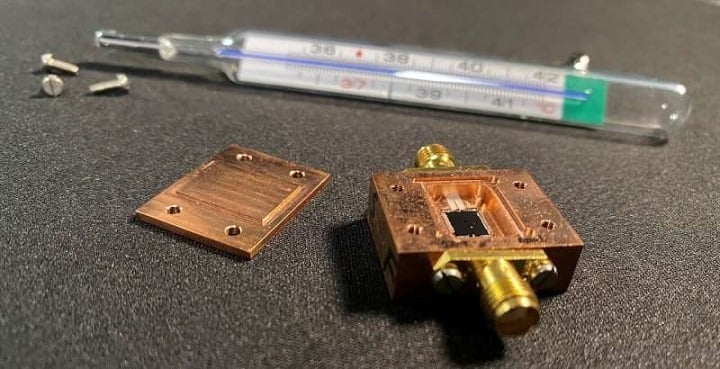 The new quantum thermometer on a chip, in the foreground, is probably the world's fastest and most sensitive thermometer for measuring temperature at the cold end of a waveguide at the millikelvin scale. Source: Claudia Castillo Moreno/Chalmers University of Technology
“A certain temperature corresponds to a given number of thermal photons, and that number decreases exponentially with temperature. If we succeed in lowering the temperature at the end where the waveguide meets the qubit to 10 millikelvin, the risk of errors in our qubits is reduced drastically," said Per Delsing, professor at the Department of Microtechnology and Nanoscience, Chalmers University of Technology.
Suppliers who rely on accurate temperature measurement to guarantee the quality of their components can benefit from using this thermometer as well. The novel thermometer also offers new opportunities for quantum computing experiments in quantum thermodynamics.
The research is published in the journal Physical Review X.