Adaptive structural elements make ultra-lightweight building construction possible
Amy J. Born | July 07, 2021Efforts to reduce the amount of raw materials, such as cement and sand, that go into the construction of buildings have been met with obvious challenges, particularly how to create the supports. Since the loads are not known in advance, safety precautions lead to oversizing even lightweight construction.
Researchers at the University of Stuttgart have developed an innovation that maintains the safety of the supporting structure and allows for significant savings of material compared to conventional lightweight construction. Their active, adaptive structural elements can be used to manipulate the way a structure handles load transfer. The active elements, actuators, are integrated into the passive support structure either in parallel or serially.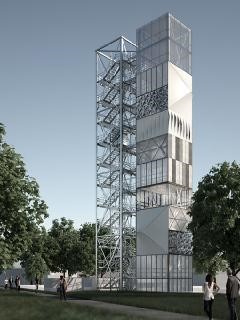 The adaptive structural elements are currently being tested in practice in a demonstration building. The adaptive high-rise building, which is approximately 37 m high, is located on the campus of the University of Stuttgart. Source: ILEK, University of Stuttgart
The actuator assemblies contain the active element and the mechanical components for the force transmission. The mechanical components maintain the pre-load in the passive state, so there is no need for additional elements to accomplish this. Each element responds to the load condition by exerting or dissipating the tensile or compressive forces. A conventional lightweight structure can, therefore, be transformed into an ultra-lightweight structure, able to actively compensate for deformations that result from dynamic and static loads.
When combined with sensors and a control unit, this happens automatically. The active elements can be activated in several ways, including pneumatically, hydraulically or (piezo) electrically.
In addition to greatly reducing the amount of material and, in turn, the overall weight of a structure, these adaptive structural elements contribute to the damping of all vibrations. This significantly increases the service life of the load-bearing structures, further reducing costs by reducing waste and disposal costs. The actuators can be used on all high-rise construction, not only lightweight construction, and can be used in bridges and other existing structures.
The researchers are testing their adaptive structural elements in a demonstration high-rise building approximately 37 m high. The building, built as part of the Collaborative Research Centre 1244 funded by the German Research Foundation, is located on the University of Stuttgart campus. Technologie-Lizenz-Büro (TLB) GmbH is offering companies the opportunity to license the patented technology or possibly purchase the property rights.