Radiative cooling system funnels freshwater from air
S. Himmelstein | July 04, 2021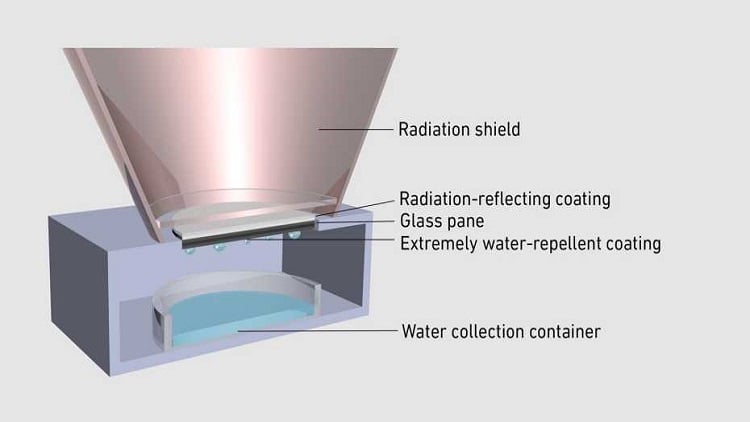 Schematic of the water condenser design. Source: I. Haechler et al. Science Advances 2021
Water-scarce regions in developing areas are expected to benefit from an atmospheric water harvesting technology that functions both day and night and without the need for external energy inputs.
The radiative cooling system engineered at ETH Zurich consists of a glass pane coated with polydimethylsilane on the top side and silver plus a superhydrophobic nanocomposite material on the bottom to both reflect solar radiation and radiate away its own heat. The device cools itself down to as much as 15° C below the ambient temperature as water vapor condenses on the underside of the pane. A cone-shaped radiation shield deflects heat radiation from the atmosphere and prevents incident solar radiation from reaching the pane shields, enabling the system to passively self-cool.
When trialed under real-world conditions on a rooftop in Zurich, the system produced at least twice as much water per area per day as the best current passive technologies based on foils. A pilot system with a 10 cm pane diameter delivered 4.6 ml of water per day, and the researchers demonstrated that, under ideal conditions, up to 0.53 deciliters of water/m2 of pane surface per hour could be harvested.
The dew harvesting capability of the system described in Science Advances approaches the theoretical limit even under demanding conditions.