Virtual Reality Tool Is Immersed in Royal Navy Projects
Mike Farish | November 05, 2015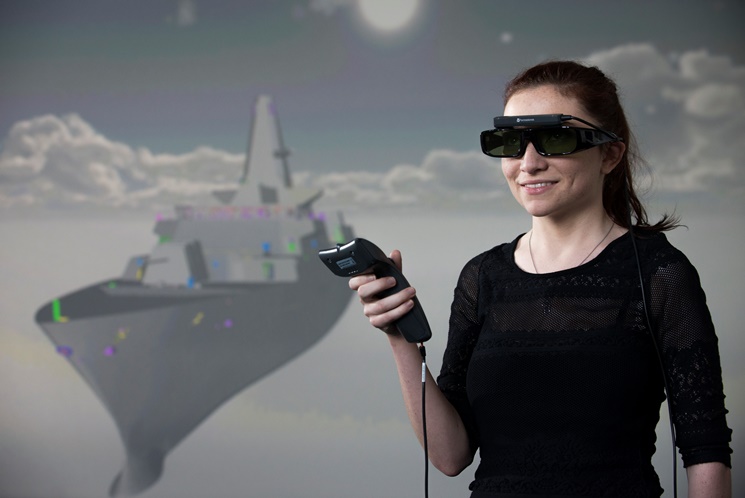 Users can “walk” or “fly” through the ship in real time by inputting commands from a handheld controller. Image source: BAE Systems
During the course of the next decade, a new generation of warship will enter service with the UK's Royal Navy. The Type 26 Global Combat Ships will be a class of destroyers specializing in anti-submarine warfare but demonstrating a “multi-mission” capability that could extend to humanitarian relief.
The ships are being designed – and also will be built by – UK-based defense contractor BAE Systems. The project marks a milestone in the company's use of at least one computerized technology: “immersive” virtual reality, which it is using for the first time in a major project as a comprehensive design verification tool. As such, multiple aspects of the ships' construction and operation will be tested in a virtual, digital world before they become a physical reality.
Program director for the Type 26 vessels Geoff Searle says that the use of the system represents an innovative step for BAE Systems in its shipbuilding operations. “It is a very new tool,” he says, and the company first began to fully use it in January. Searle says that 400–500 design and systems engineers may be involved at any one time and that around three quarters of them are likely to use the system. For a core of about 150 engineers, the system is a “day-to-day” tool, he says.
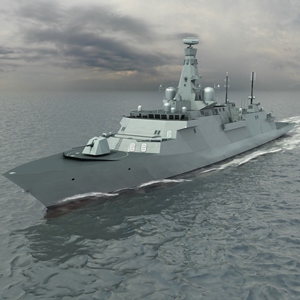 Artist’s rendering of the Type 26 ship being developed for the UK Royal Navy. Image source: BAE Systems.One of those for whom working with the system is a daily experience is Mark Villiers, visualization manager for BAE Naval Ships. He says that BAE regards the capability as more than just a design verification tool. Instead, in corporate jargon BAE hopes to achieve a complete “through life capability.” What that means is that the system will be used not just to support conceptual and detail design – in the former case testing out, as Villiers puts it, a range of “what-if scenarios” - but also as a tool for “virtual build” of vessels so that assembly procedures can be verified before they are implemented.
Off-the-Shelf
The actual system used by BAE is an off-the-shelf commercial product from software supplier Virtalis. Villers says that after a short pilot program, the software was implemented at five locations across the UK – three sites in Glasgow, one in Portsmouth and one in Bristol – during a six-month roll-out from June-November 2014. Glasgow is where the vessels will be built. Meanwhile, the Bristol site allows for co-location with BAE staff of UK Ministry of Defense personnel. Indeed, Villiers says that the way that the system facilitates the participation of “customers” in the design and development process is important in ensuring that the ships are fit for purpose.
Each installation is based around a screen display that measures four meters wide by three meters high. Users wear special glasses that convert the otherwise unexceptional screen image into a 3D representation of any part of the ship. Users then can “walk” or “fly” through the ship in real time by inputting commands from a handheld controller. The VR imagery is created by porting into the Virtalis system 3D modelling data generated in the CAD system used by BAE for ship design. This is the FORAN system from Spanish company Sener that Villiers says is among the standard systems for ship design worldwide. Villiers says that the multiple “terabytes” of data that are needed to represent a complete ship model in the CAD system are reduced to a “lightweight model” of “just” three gigabytes in the VR system.
This reduction is crucial to the modest processing power required by each installation; Villiers says that in each case the necessary hardware is the equivalent of a high-end computer workstation and costs roughly £10,000 ($15,000). Moreover, system operation is easy: Villiers says that an hour of familiarization is all that is required to turn a novice into an accomplished user. A higher level of competency is needed to process static CAD data into the dynamic form it assumes in the VR system, but that is within BAE's own in-house capabilities.
 Without fail, everyone who has seen its capabilities is reporting benefits, says Mark Velliers.However, the real power of the system derives from the fact that each installation is networked to the others to form what is, in effect, a single UK-wide VR system. As such, says Villiers, the crucial capability is that of simultaneous, collaborative working for team members irrespective of their location.
“We have the ability to network in real time and hold virtual design reviews across the whole network if required,” he says. “It makes possible a far more collaborative approach to the design lifecycle with key stakeholders in the same room alongside design engineers as well as other staff all accelerating the design process.”
Adoption Drivers
But, as Villiers also says, VR is not in itself a new technology. So why has BAE Systems now decided to implement it as a pervasive tool for naval ship design and development? There are, he says, two main drivers.
First is an “absolute requirement to accelerate our design lifecycle for the Type 26 project,” he says. Second is that the technology has reached a point where the sheer volume of data involved can be processed and manipulated in a way that enables the level of capability required.
In practical terms, Villiers says that it is already possible to identify specific instances where the VR system has provided solutions to problems that might otherwise have become apparent only much later. One example involved “proving out the removal route for diesel generators.” In consequence, he says, “we now have a robust plan for doing so and have proved it to the relevant stakeholders.”
At a more general level, Villiers says that the “safety sign-off” procedure through which the ship is deemed free of hazards on a compartment-by-compartment basis has been brought forward from the physical to the virtual world. Previously, the individual charged with that responsibility would have had to wait until the ship was actually being built before he or she could identify features that had the potential to compromise crew safety. In the Type 26 project, however, safety engineers have been able to provide feedback to the design engineering team before construction ever began.
Given that there are upwards of 800 compartments in the ship, the potential for averting what might otherwise be time-consuming and costly remedial measures is considerable. Indeed, Villiers himself is impressed: “The ability to perform digital prove-out way ahead of any physical build and commitment to tooling is just fantastic.”
One goal that BAE has set is to broaden the acceptance of purely digital design verification procedures. “We want to achieve a progressive digital acceptance of the ship with our customer so that when they take delivery it is right first time,” Villiers says. Moreover, once that level of confidence in VR is achieved, then not only can the ship’s physical integrity be tested digitally, but crucial ways in which it will be used also can be tested. As one example he mentions the ability to test the evacuation routes that the crew might use if forced to abandon ship.
System Expansion
BAE's confidence in the system is such that its use is now being extended into at least two other naval ship development projects. One is for a new class of patrol boat, the River Class Batch 2. In this instance Villers says detail design had already been almost completed when the VR system came on-stream.
The other is the project to build two 70,000-tonne Queen Elizabeth Class aircraft carriers. Again this Royal Navy project is ahead of that for the Type 26 vessels – the first carrier is already in the water – but Villiers says that the VR system has been useful in supporting final internal layout design. On that count, he rsays, the VR system has helped reduce the time needed to analyze the proposed configuration of HVAC (Heating, Ventilation and Air-Conditioning) equipment in one compartment from the two days required using CAD data to 45 minutes.
Villiers says the VR system has impressed all those who have witnessed what it can do. “Without fail everyone who has seen its capabilities is reporting benefits,” he says. “It is enabling them to make decisions and progress the design far more quickly they have ever been able to do.”