The technical side of ice cream
Ryan Clancy | June 17, 2021Ice cream is a delicious way to help beat the heat on a summer’s day. Modern innovations mean its availability is convenient, and has also given birth to soft-serve.
Ice cream is a combination of milk, sugar and cream as its foundation, and then whatever extra ingredients one chooses to add to it, as there are countless! It has been an extremely popular dessert for hundreds of years but became a household favorite with the introduction of widespread refrigeration. There have been various forms of the frozen desert including frozen yogurt, frozen custard and versions without dairy that are made with nut milks like coconut milk.
History of ice cream
The history of ice cream starts with snow, yes, the ice that falls from the sky. It was gathered from mountains in Japan around the fourth century but was only stored inside in Europe from the 15th century onward. The very first version of ice cream was snow flavored with sugar syrups poured over the top of it. These were typically found in China or Persia, and were flavored using lemons, citrons, rosewater, ambergris and violets. In Europe, nut and fruit flavors were favored, with pistachio and hazelnut being particularly popular.
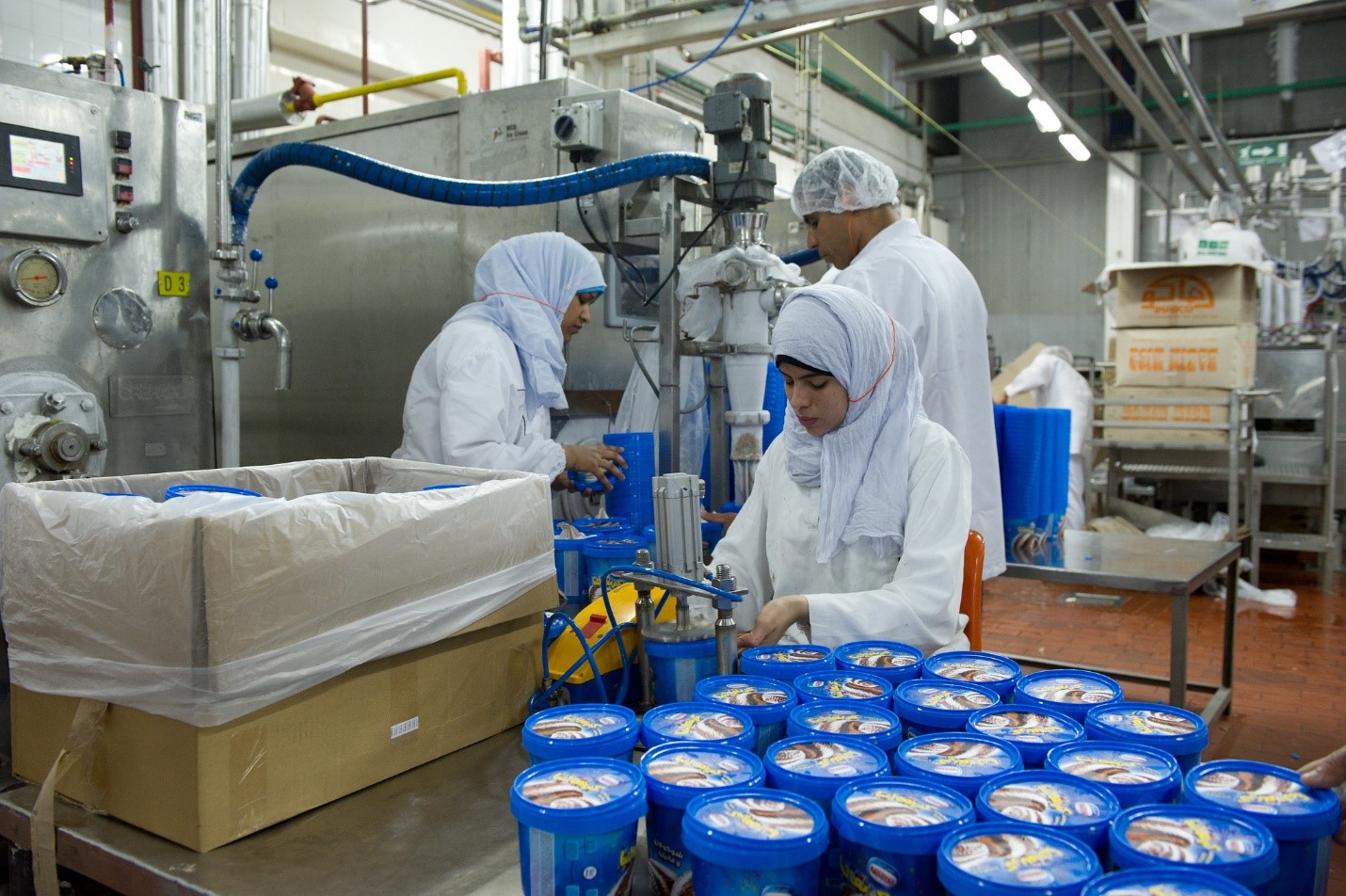 Source: Nestle/CC BY-NC-SA 2.0
Materials
As mentioned previously, ice cream is a blend of dairy products (condensed milk, cream and butterfat), flavorings, sugar and other federally approved additives. Eggs are sometimes added for specific flavors, including French vanilla. The guideline for making ice cream is quite broad, as ingredients can range from nonfat dry milk to sweet cream, corn-syrup solids to cane sugar, powdered eggs to fresh eggs. One firm rule is that here must be at least 10% butterfat in the mixture for it to be officially classed as ice cream.
The additives also act and stabilizers and emulsifiers, and they prevent heat shock and ice crystals from forming during the manufacturing process; more on that later. Typical additives to the mixture are guar gum, which is made from the guar bush, and carrageenan, which is made from Irish moss or sea kelp.
Air is also added to ice cream to increase its ability to absorb flavors and to make it easier to serve. If the ice cream does not have any air added to it, it will become soggy and heavy. However, too much air and the ice cream will by dry and snowy. Ice cream can have up to 100% of its volume in air, which is referred to in the industry as overrun. For example, gourmet ice cream makers typically use fresh whole fat dairy products, with a relatively low percentage of air (around 20%), and around 16% to 20% of butterfat. They also try to limit the number of additives they use.
Manufacturing process
Ice cream can come in a variety of forms, including the ice cream sandwiches we all know and love, and chocolate dipped bars. The following description refers to ice cream that is packaged in half-gallon and pint containers:
Blend the mixture
Milk arrives at the manufacturing plant inside refrigerated trucks. It is then pumped into 5,000-gallon storage silos that are constantly kept at 36° F, or 2° C. Pipes transport the milk in specific amounts to 1,000-gallon blenders made out of stainless steel. Specific amounts of sugar, eggs and additives are then also added to the mix for generally around six to eight minutes.
Kill bacteria by pasteurizing
The newly blended mixture is brought to the pasteurization machine, which is made up of thin stainless-steel plates, with hot water at around 182° F flowing on one side. The cold mixture flows on the other side of the plate, and is warmed to about 180° F, which kills any bacteria that is present.
Homogenizing the mixture for an even texture
Intensive air pressure is applied to the hot mixture then to force it through a little hole into a homogenizer. This breaks down the particles of fat in the mixture and stops them from separating from the mix. The mixture is further blended by the homogenizer which works similarly to a piston pump.
Resting and cooling to amalgamate the flavors
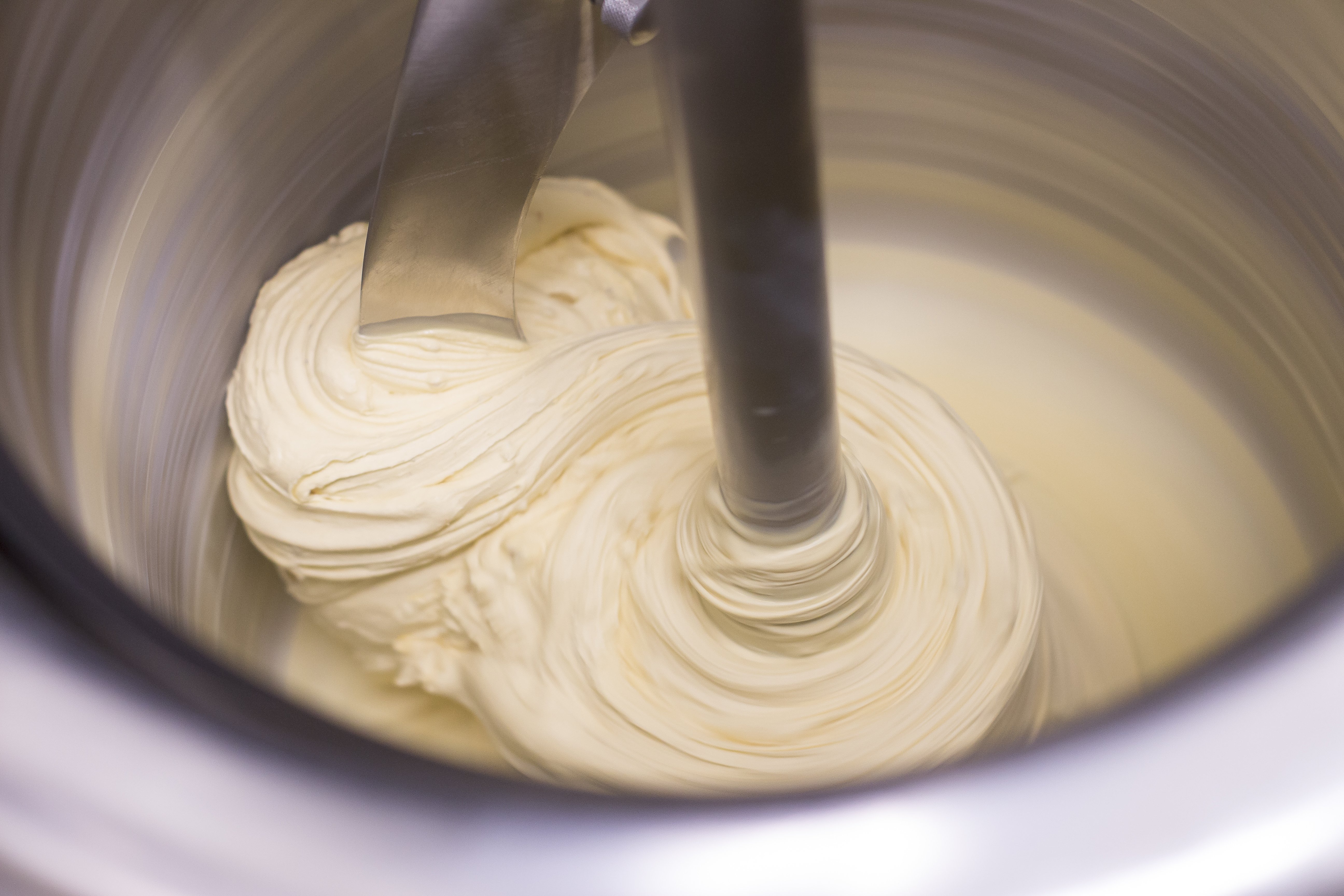
After the homogenizer, the mixture is brought back to the pasteurizer again where cold water (34° F) flows on one side of the plates as the mixture flows on the other. The brings the temperature of the mixture down to 36° F, and it is then pumped from the pasteurizer to another 5,000 gallon tank in a different room also maintained at 36° F, and it rests here from four to eight hours while the ingredients mix together and the flavors blend.
 Source: Adobe Stock
Flavor the ice cream
To flavor the ice cream, the mixture is brought to smaller 300-gallon vats where additives and flavorings are added as needed and blended thoroughly.
Freezing for soft serve consistency
When the mixture is of desired temperature and taste, it must then be frozen to bring it to the correct consistency. It is brought to continuous freezers that can freeze 700-gallons per hour, and the temperature inside of these freezers is minus 40° F. While the ice cream mixture is in this freezer, air is mixed into it, and once it leaves these freezers it has the consistency of soft-serve ice cream.
Hardening
Before ice cream can be stored and/or packaged for shipping, it must be hardened to a temperature of minus 10° F. The ice cream is moved in its container to a tunnel that is kept at -30° F. Ceiling fans that are constantly turning create a wind chill of -60° F. The ice cream is moved back and forth until it is completely solid, and it is then stored in refrigerators until it is shipped out.
Future of ice cream
New flavors are constantly being developed by ice cream manufacturers. One of the most recent trends, which is ironic considering its surge in popularity during the prohibition, is the emergence of alcohol and cannabis-infused ice creams.