Adsorbent created to clean copper from water
S. Himmelstein | December 06, 2020A new crystalline material formulated by an international research team promises to improve the efficiency of heavy metal removal from water. A zinc imidazole salicylaldoxime supramolecule (ZIOS) adsorbent was demonstrated to target and trap copper ions from wastewater with precision and speed.
The crystals of this hydrogen-bonded organic-inorganic framework were demonstrated to be highly stable in water for up to 52 days. In contrast to metal-organic frameworks, the material was also observed to perform well in acidic solutions with the same pH range of acid mine wastewater. ZIOS selectively captured copper ions 30 to 50 times faster than state-of-the-art copper adsorbents.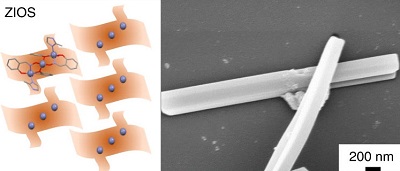 Schematic diagram of a ZIOS network (left) and a scanning electron microscopy image of a ZIOS-copper sample on a silicon wafer (right). Source: Ngoc T. Bui et al.
Nanochannels in the adsorbent are just 2 to 3 angstroms, the size of a water molecule, and expand when immersed in water. This mechanism allows water molecules carrying copper ions to flow at a larger scale, during which coordination bonding reactions occur between copper ions and ZIOS. When water is removed from the material, the crystal lattice structure contracts to its original size within less than 1 nanosecond.
The researchers from Lawrence Berkeley National Laboratory, National Synchrotron Radiation Research Center (Taiwan) and University of California Berkeley hope to adapt these adsorbent design principles for the selective removal of other pollutants. A paper on this study is published in Nature Communications.