An efficient, low-cost approach to radiative cooling
S. Himmelstein | October 23, 2020Radiative cooling techniques have been tested by many energy conscious building designers and engineers by installing structures on windows or walls that reflect solar radiation or radiate far-infrared light. These methods are intended to reduce internal building temperatures and electricity use by redirecting radiative heat but can be difficult to apply in large areas. A simple solution devised by researchers in South Korea uses silica-coated porous anodic aluminum oxide to achieve energy-free radiative cooling.
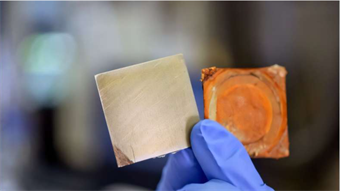
The materials demonstrated a maximum cooling effect of 6.1° C compared to the inner ambient temperature 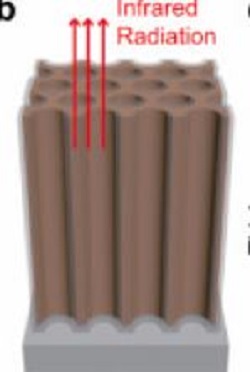 Schematic representation of the designed radiative cooler using silica-coated porous anodic aluminum oxide. Source: Dasol Lee et al.even under direct sunlight. Experiments confirmed that an optimized single membrane structure can have a reflectivity of 86% in the solar spectral region and a high emissivity of 96% in the atmospheric window. An average cooling flux of 65.6 W/m2 under direct sunlight during the daytime was determined.
Researchers from Pohang University of Science and Technology, Korea University and National Institute of Nanomaterials Technology envision mass production of a low-cost silica-coated porous anodic aluminum oxide radiative cooler to reduce global energy consumption.
A paper on this study is published in Nano Energy.