Innovative heat trace solutions for thermal maintenance
Chris Myers, Director of Heat Trace, Chromalox | September 17, 2020Founded in 1917 by self-taught engineer Edwin L. Wiegand, Chromalox provides a full line of heat trace products, industrial heaters and associated components. Headquartered in Pittsburgh, Pennsylvania, Chromalox has grown to a global presence in its more than 100 years of history, including 2,000 authorized distributors, and well over 600,000 sq ft of manufacturing space.
Why heat trace?
In many industrial and commercial applications, name="_Hlk49776070">a sufficient drop in temperature, especially when combined with precipitation, means unacceptable consequences. Such a drop can mean frozen water in cooling lines or fire protection systems, unintended condensation in steam or compressed air lines, buildup of snow and ice on rooftops and more.
In piping applications, physical insulation is used along with electric heat tracing to prevent energy from escaping into the atmosphere. This setup allows piping to maintain acceptable temperature values, even when the ambient temperature is much lower than the fluid inside. Applications vary from high-temperature, flowing steam lines, to water inside of fire protection lines that are primarily static and must be kept warm enough to prevent freezing.
This article will primary focus on piping applications, although, it is important to note that the same sort of heat trace technology can be used to deal with excessive snowfall on buildings during the winter. In those instances, Chromalox’s products are meant not to completely melt the snow and ice from a rooftop, but to maintain an open path to allow water to drain. Similarly, heat trace can be used to elevate temperatures of freezer floors and other similar situations, in order to prevent structural damage via thermal expansion.
Sustainable and transparent free protection
Three parking garages, which require freeze protection on pipes and plumbing, are planned as part of Nashville International Airport’s (NIA) major $1.2 billion expansion. A project of this magnitude requires a modern solution that offers remote monitoring of pipe temperature, current level and fault detection for the whole system.
A local contractor installed a Chromalox heat trace system, including temperature sensors that signal the panel when to power the heat trace to keep the pipes operational without wasting energy. In the event of a sensor failure, a baseline power percentage is supplied to prevent freezing.
The system with sensing solutions saves NIA the expenses associated with maintenance due to system-level transparency and smart energy use, when compared to alternative technologies.
Chromalox heat trace offerings
Chromalox offers three main technologies in heat tracing solutions, used in both commercial and industrial applications.
 Figure 1: Heat trace wire is a key part of roof de-icing, preventing ice dams, icicles and damage to people or equipment. Source: Chromalox
Self-regulating heat trace dynamically changes its thermal output throughout a cable’s length depending on temperature. Within this family, users can choose from different types of cables based on their temperature and heat output needs. This innovative heat trace solution is discussed in more detail below.
Constant wattage heat trace is best suited for applications where a particular watt density is required at all times. This type of heating cable is constructed of nichrome wire wrapped around parallel insulated bus wires, connected at alternating intervals to create a network of parallel resistive elements along the length of cable. Cabling can be cut to length in the field, and can be used at a standardized 120, 208-277 or 480 V rating. Constant wattage systems can withstand exposures of up to 392° F. Power output is limited to 12 W/ft.
Mineral insulated (MI) heat trace cables consist of one or more metallic heating elements, surrounded by compacted magnesium oxide (MgO), and are the most rugged heat trace cables in the Chromalox product line. These cables are factory assembled and tested. Therefore, all construction information must be known in advance, and future field modifications are extremely difficult. These heating elements are not just rugged, but extremely capable, and can be powered by up to 600 V AC, producing an energy output as high as 50 W/ft. Temperature maintenance of up to 1,112° F is possible, with exposure ratings of up to 1,200° F.
With these technologies, and specialized versions for specific applications, Chromalox can provide the exact solution needed for a wide variety of situations. Self-regulating heat trace technology is an especially interesting concept, which merits further discussion below.
Self-regulating cable
While MI and CW heat trace work well in some applications, self-regulating (SR) cable is the newer technology in this space, featuring a very innovative working principle. Rather than using a metal heating element, SR cables utilize semiconductive polymer core as the heating element. This semiconductive polymer is extruded over parallel bus wires, and as the polymer contracts or expands, microscopic electrical paths form and disconnect, creating seemingly infinite parallel paths for electricity. Current flow is thus automatically regulated based on an area’s temperature profile and reacts to heating needs automatically at certain areas.
Cables can be cut to length in the field, and there is no overheating danger with cables that overlap. Since as temperature increases, heat output decreases dynamically, if cables do overlap — by design or mistake — heat output is not doubled. The system simply compensates for this situation through lower power output in the overlap area without further operator interaction.
For specification purposes, the nominal output rating of SR cable is specified at 50° F. Low temperature cables can maintain temperatures up to 150° F, and high temperature cables can maintain 302° F, with exposure ratings up to 420° F. Notably, low temperature versions of this heat trace product can be used with plastic pipes and vessels, unlike MI and CW products. Industrial low temperature SR cable can output up to 10 W/ft, while industrial high temperature SR cable doubles this to a maximum of 20 W/ft.
This type of cable can be used in freeze protection and snow melting/de-icing applications, as well as with insulated pipe. Given the dynamic nature of snowfall and roof arrangements, such a variable heat output ability could be an especially attractive option.
Advanced heat trace controls
In addition to the heat trace cable itself, Chromalox offers an industry leading controls lineup that is simple to use, while providing data feedback and alarms that can reduce downtime and help extend the life of the system.
Controls range from simple mechanical thermostats that provide freeze protection, to large industrial heat trace control panels that feature HMIs. The HMI is a user friendly touch screen computer. It displays the process variable, temperature setpoint, alarm status, current load, control mode, sensor failure and manual override output for any two or six loops at a time as well as the alarm status for all circuits.
To access data from anywhere, Chromalox offers an IIoT (industrial internet of things) gateway or ISC software to allow for seamless real-time connectivity. Their C2i™ technology platform provides an integrated intelligent network of control technologies, component products and systems to ensure system integrity. name="__DdeLink__1520_2322822913">C2i™ not only allows for enhanced predictive and preventive maintenance, but it can also help remedy breakdowns when they do occur.
Putting it all together
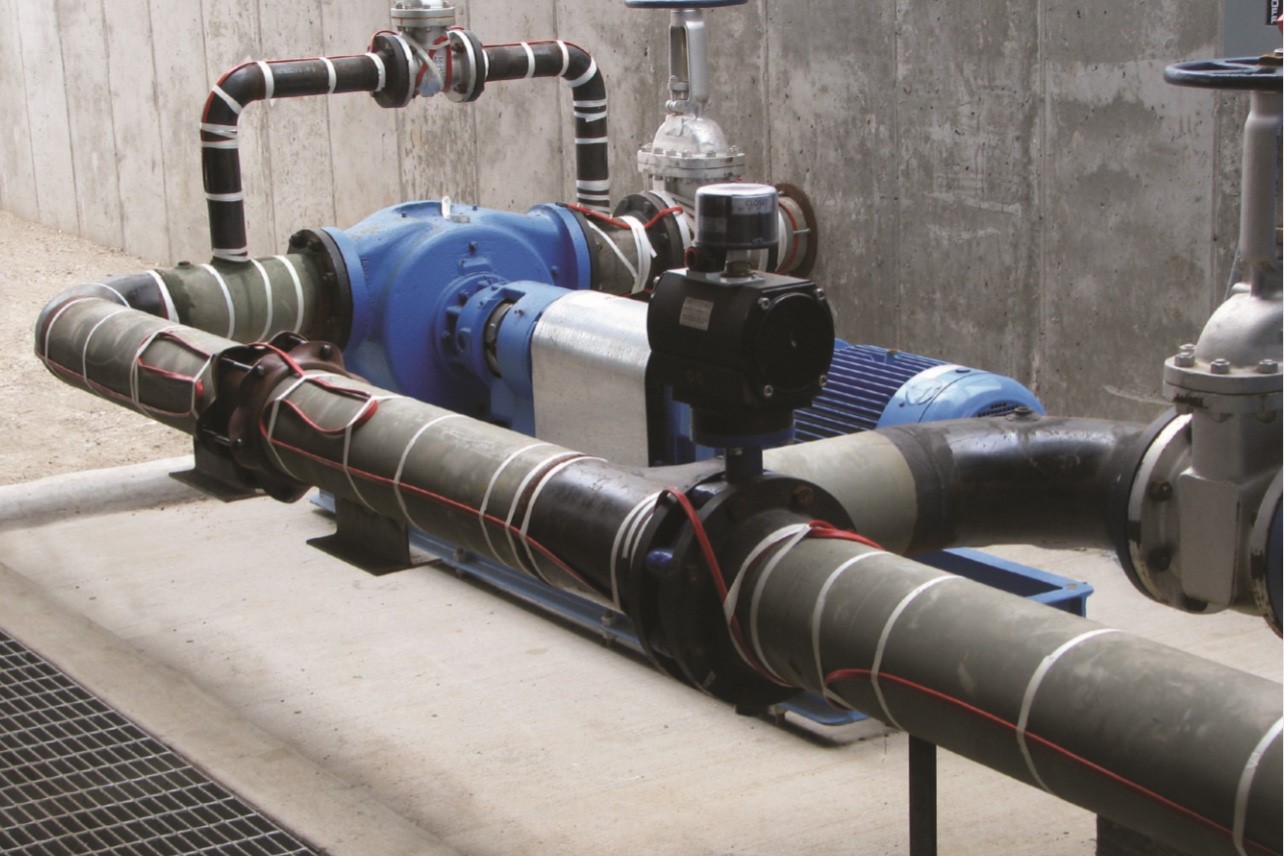 Figure 2: A heat trace pipe installation. Source: Chromalox
A typical self-regulating heat trace pipe installation would involve a controller such as Chromalox’s IntelliTrace system, which can control up to 72 heat trace loops at 40 amps per circuit. This system includes full monitoring, sensor mapping and a variety of control options. It also includes programming via a touchscreen HMI, and can be specified for ordinary or hazardous areas. Alternatively, a heat trace system could be controlled with the more limited, but compact ITC controller, which controls one or two circuits with solid state relay (SSR) technology and utilizes an 8 in x 10 in x 8 in enclosure.
With the main control options sorted, a power connection box is applied to the start of a heat trace circuit, attached with a pipe strap. This power connection box provides power to the heating cable, which is applied along the temperature controlled pipe, and fastened down with fiberglass tape at regular intervals. Heat trace cable is generally arranged at 45° below the horizontal centerline of the pipe. If two cables are needed, each can be arranged at 90° to one another, maintaining mirrored 45° angles below a horizontal centerline for both. Heat trace cable is looped over flanges and valves as needed.
Multiple entry connection kits can then be used to split the heating cable, which is also attached to the pipe with a pipe strap. An above insulation end seal kit, or a below insulation end seal kit, is used to end the heat trace circuit and protect the heat trace from moisture. Over the top of the cable, insulation is applied to direct the heat into the pipe itself rather than the environment. A warning label must be applied to let personnel know that electric heating is present on the pipe.
Providing more than products
Vancouver has strict enforcement of complex building codes, and small infractions can lead to costly delays. So, when an insulation contractor in Port Coquitlam, Canada, had a customer who needed a heat trace system on a fire sprinkler line, Chromalox’s engineering and expertise became critical.
Contractors prefer to work with responsive suppliers who offer installation and operation expertise as needed. This helps ensure that they meet challenging codes and industrial standards, including UL 515A, the industry’s most stringent standard for freeze protection of fire suppression systems.
Chromalox for all heat trace needs
With a wide array of heat trace and control products from which to choose and a vast amount of experience, Chromalox can help with design on the front end, along with startup and commissioning services to ensure that a new system is installed correctly and running properly. This proper installation means a potentially extended service life, and low maintenance operation well into the future. When the time comes, Chromalox also stands ready to assist with upgrades and repairs, as well as with cold weather audits.
Maintaining temperature with heat trace, whether in the form of mineral insulated, constant wattage or self-regulating cable can be an attractive value proposition, as much less energy is needed to provide supplemental heating and to maintain pipe temperature than to raise it in the first place. On the other end of the spectrum, the potential damage that can occur when temperature drop in an uncontrolled manner can be extremely expensive and disruptive to the process. Whatever the need, heat trace products developed by Chromalox over its century-long history can be a perfect solution to keep processes running efficiently, while avoiding unplanned downtime and repairs. For more information, contact Chromalox.